
PRODUCT LEADERSHIP & DESIGN STRATEGY
·
B2B TELECOM SAAS & MARKETPLACE
Making B2B telecom work as a SaaS marketplace.
For Netwo, I mapped the interconnected journeys of operators, resellers and business teams to frame a single B2B connectivity platform, then built the first Design team capable of evolving it.

In short
Netwo launched in 2020 as a telecom-tech SaaS platform: a “one-click operator” aggregating multiple infrastructure operators behind a single interface, enabling service operators and resellers to sell connectivity without carrying the full complexity of the underlying information systems themselves.
I joined as the first designer on the initiative, while the Product strategy was still largely based on assumptions and no Design team existed. I defined the Product Design framework for this B2B SaaS from the ground up: understand the domain, model the product, frame the MVP, then build the team and Design system capable of evolving it.
I conducted 30 field interviews to map nine personas and their interconnected journeys across the service lifecycle (sales, deployment, delivery, billing, service management, relocation, termination and cross-cutting operations) then turned that work into shared models and prioritisation workshops that framed the MVP.
With the Lead Product who joined during the engagement, we recruited and structured Netwo’s first six Product Designers, with a documented Design cadence built to continue after we left.
Map reality to refine product-market fit
Netwo brings together infrastructure operators, resellers and end customers across nine different but complementary professional profiles (network CTOs, sales administrators, salespeople, reseller executives, network engineers and end-customer CIOs) each with their own motivations, frustrations and tasks.
When I arrived, the product was being built around assumptions about how these people worked, without a real view of the system as a whole.
In that kind of complexity, understanding the objects, actors, rules and dependencies shaping their work comes first. I interviewed 30 people across the target profiles, giving the founding team the precision their Business and Tech assumptions were missing: an X-ray view of where Netwo could actually create value.
Each interview combined hierarchical task analysis with emotional mapping: triggers, outcomes, context, motivations, obstacles and opportunities, through to targeted phenomenological immersion.
That rigour produced personas grounded in real tasks and the strongest needs on which to build a compelling value proposition.
Sophie, sales administrator persona, was caught between different supplier pricing systems: “We check eligibility on several websites. There are different price grids, different formats… you have to bring everything together for the customer.”
How might we centralise eligibility across all infrastructure operators in a single check?
Jean-Christophe, Sales persona, was still assembling every quotation manually: “I have an Excel file. I go and find the products here and there, calculate my margin, apply my coefficient, then copy-paste everything into PowerPoint.”
How might we give Sales enough product visibility to compose an offer?

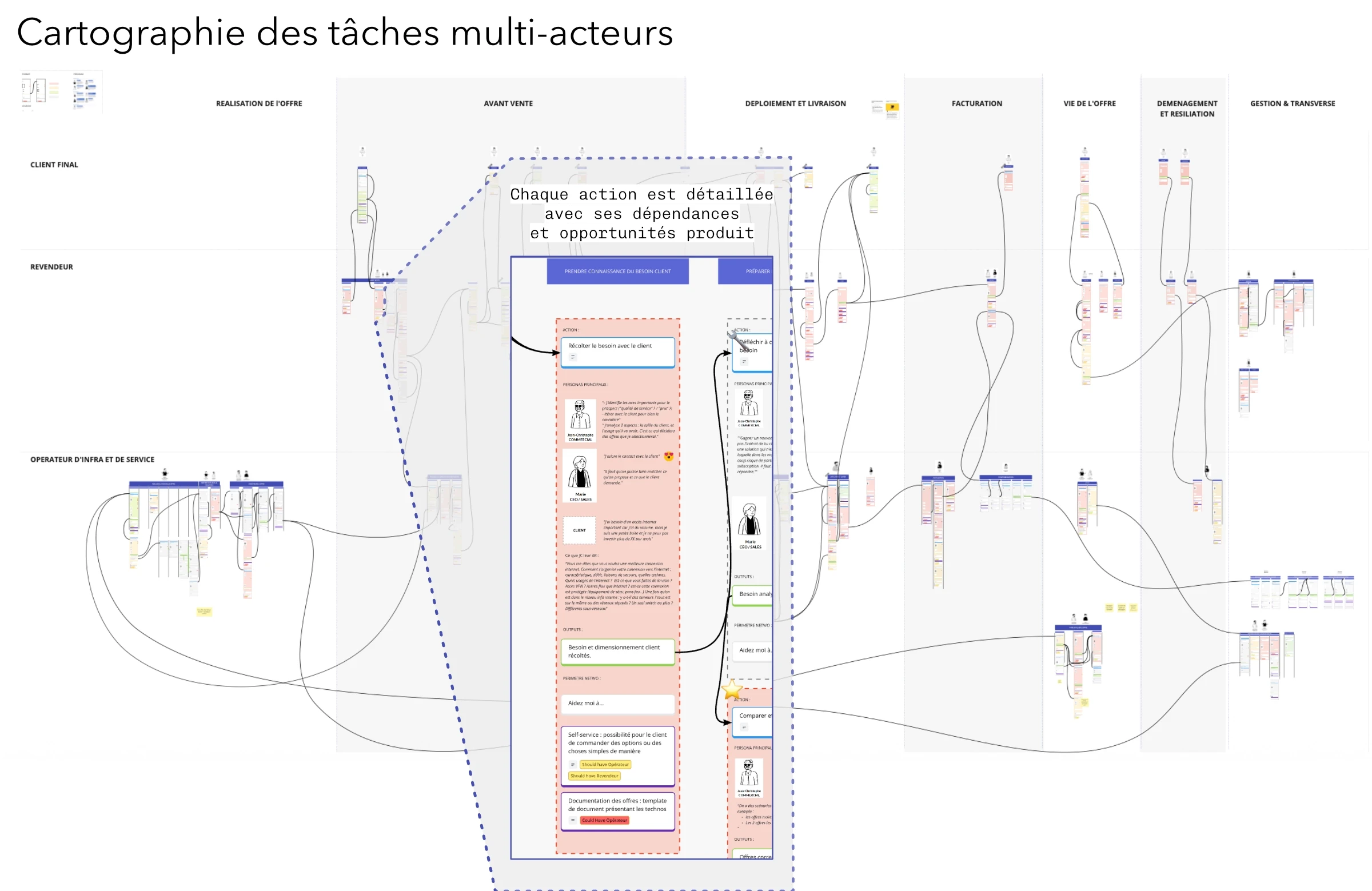
I then represented the complete flow across infrastructure operators, service operators and resellers as one journey connecting personas across nine phases of the service lifecycle.
Every step showed how one persona supplied another with information, questions or blockers.
For Gaëtan, CTO persona on the operator side: “Marketing sometimes has the final say on what is feasible or not. Best case, we’re just executors. Worst case, they’ve sold something that can’t actually be delivered.”
How might we turn network constraints into Product rules that Sales can use at the point of sale?
Sarah, Financial persona, carried the financial health of the company: “My role is to safeguard the company’s future by making sure it is properly financed.”
How might we give her a consolidated, real-time view of margin by product and by customer?
Céline, the lawyer persona responsible for the contractual framework, summarised her role in a sentence that shaped how we modelled master agreements in Netwo:
“A contract is the story of the relationship that will bind two people who both have a lot of expectations and fears.”
How might a master agreement evolve with the commercial relationship without having to be rewritten from scratch?
Once the model was clear enough, we could make both strategic decisions (what should the product be?) and operational ones (how does this rule become a workflow, a state or an interaction) ?
Break down the technical system
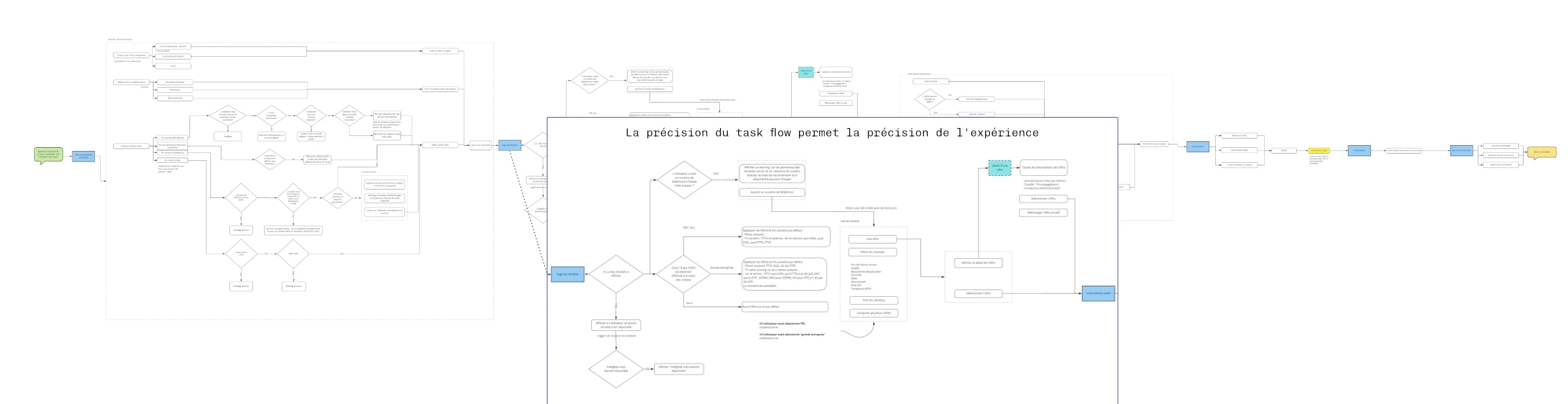
"Dedicated fibre", "shared fibre", "copper connection": each connectivity technology follows a different workflow, with its own rules and real-world exceptions (damaged ducts, blocked worksites, customers missing appointments, network capacity issues, unmet customer prerequisites…).
I conducted secondary research across numerous telecom infrastructure processes to identify where Netwo could genuinely improve the system.

This mapping turned operational knowledge previously held by a handful of domain experts into a set of Product rules that designers and developers could use.
Each key process entering the product was broken down into interaction task flows, and each field edge case became a documented state or rule instead of a recurring support ticket.
Set Netwo’s scope
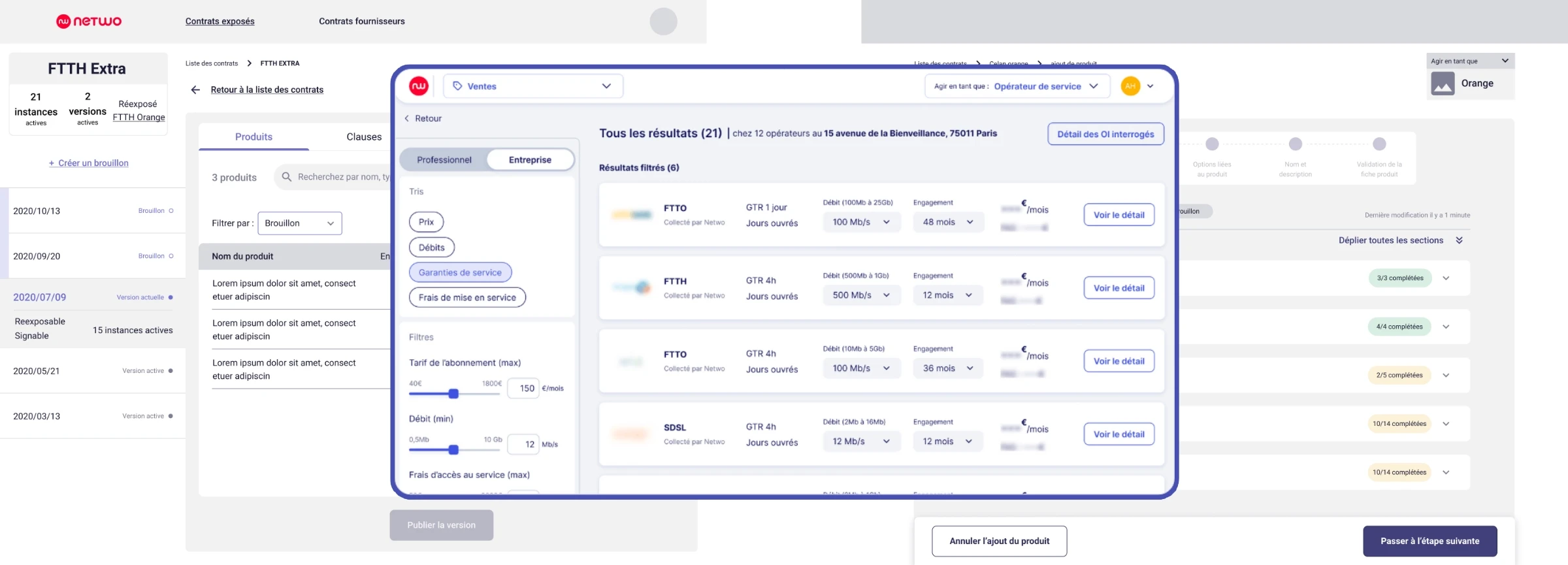
Once the exploratory research had created enough clarity, we designed and facilitated prioritisation workshops bringing together the opportunities that removed the most user friction, the Blue Ocean business strategy identified by the founders, and the development team’s technical strengths.
We had to decide which complexity the product should absorb, which it should expose, and which it could eliminate.

We had to decide which complexity the product should absorb, which it should expose, and which it could eliminate.
ELIGIBILITY
Before: dozens of supplier constraints.
Now: one entry point.
CATALOGUE / QUOTATION
Before: scattered products and manual margin calculations.
Now: offer composition inside the product.
ORDERING
Before: technical processes and field exceptions.
Now: explicit workflows and statuses.
AFTER-SALES / SUPPORT
Before: tickets and diagnostics scattered across suppliers.
Now: centralised monitoring and speed tests within a single ticket.
CONTRACTS
Before: commercial relationships constrained by legal complexity.
Now: modelled master agreements and clauses.
RESALE
Before: every reseller rebuilds the offer from scratch.
Now: one-click resale of an existing master agreement under the reseller’s own brand.
PROFITABILITY
Before: fragmented data.
Now: a consolidated view of margin.
BILLING
Before: manual reminders and payment reconciliation.
Now: automated monitoring of payments and outstanding invoices.
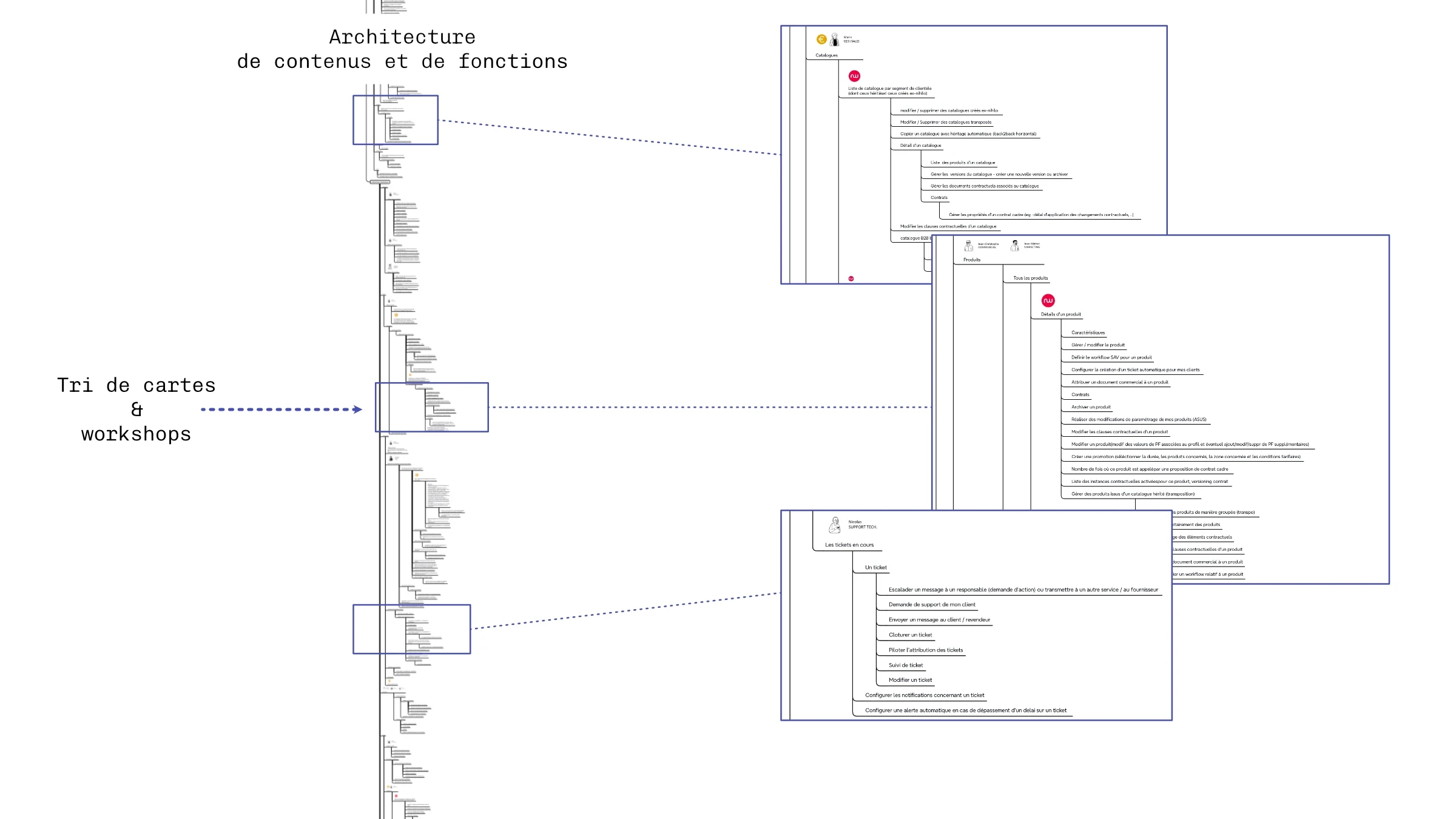
The result directly shaped the platform’s information architecture and Product roadmap.
Build the Design function
Netwo had no Design team when I arrived.
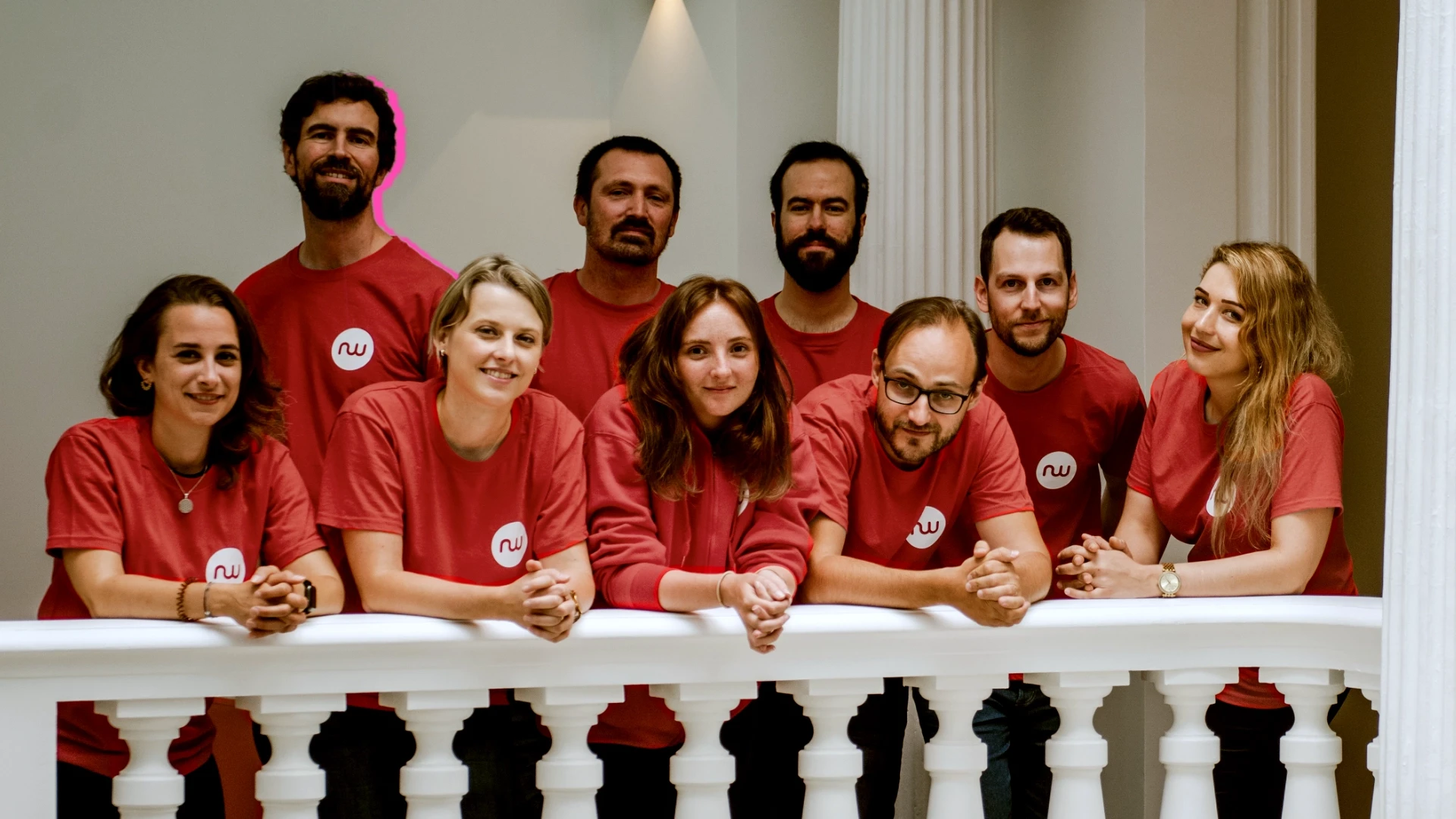
Together with the talented Noémie Lecorps, the Lead Product who joined during the engagement, we recruited the first six Product Designers and defined the operating model that would enable them to design the product.
We needed to establish what Product Design meant at Netwo: its scope, its involvement in Product strategy, its relationships with Product, Tech and domain experts, and how a feature should move from an abstract problem to a solution in production.
Beyond the structure we put in place, those six strong Product Designers are the people who went on to make Netwo what it is today, and I’m happy to recommend them: Alice Habay, Florence Doan, Jérôme Madrelle, Hadrien Rolin, Pierre Jamet, et Margaux Perrier.

Together, we formalised a two-week Design sprint cadence. Every new Product capability followed the same sequence:
Business context;
feature architecture;
pragmatic features and hedonic elements using the Kano model;
user journeys;
benchmarks and anti-inspiration;
then UX/UI + development co-design through mob design-programming, validated through user testing.
A process tested, repeated, adopted and documented step by step—reproducible without supervision, yet flexible enough to improve through regular feedback.
Un SaaS qui gère la complexité du métier n’a rien gagné. Un SaaS qui en fait un avantage concurrentiel a tout changé.
Ultimately
When I arrived at Netwo, there was no Product Design team and the Product strategy still relied heavily on assumptions.
In eight months, my role as Lead Designer helped us:
understand the domain;
model the system;
frame the product;
begin designing the MVP;
recruit and structure the first six Product Designers, together with the Lead Product.
The most important result was turning difficult-to-share domain complexity into a model that Business, Design and Tech could work on together, then turning that model into an organisation capable of continuing to design with speed and rigour.
Netwo was acquired by Groupe Altitude in 2023, by then established as a reference platform in the B2B telecom market.
That is not an outcome I can directly claim, three years and another team had passed in the meantime, but it is a signal that the foundations I helped lay contributed to a well-earned success.
Postscript
Give me a B2B SaaS team working in a domain that seems impossible to understand, distributed across dozens of rules and multiple categories of actors.
We’ll go into the field, unfold the system, model it, turn it into a differentiated Product architecture, and co-design it closely with the other teams, transforming that complexity into a coherent, powerful and desirable product.
A product that does more than manage domain complexity: it turns it into a competitive advantage.
Turning domain complexity into competitive advantage.
Open to a permanent role
If your organisation needs to unfold a complex system and turn it into a coherent product, let’s talk.