
DESIGN MANAGEMENT
·
HEALTHTECH
Designing the organisation behind better digital health products.
From strategy to research to delivery, I built a shared operating infrastructure that helped Product teams make decisions and move forward with greater confidence and impact.

In short
I joined Biogen Digital Health as Head of Design & Research with the expectation of leading 15 designers and researchers across six products. Between signing and my start date, a new CEO cut technology and innovation budgets, leaving me with two designers and two researchers.
Rather than reacting to the immediate pressure, I spent my first two months observing how the teams actually worked and co-defining five precise strategic goals, and how we would reach them, using a product framework applied to the Design function itself: the Opportunity Solution Tree.
Over the following two years, we turned most of that plan into reality: an evidence-based decision system, a cross-team briefing culture, and, on our flagship product Physio.me, a complete strategic reframe of the patient experience.
The story ended with another new Biogen CEO and a “Fit for Growth” plan that closed departments outside the company’s core pharmaceutical business. We said goodbye with the satisfaction of having built something excellent. The proof came while we were training the organisations taking over our products: every member of the Design & Research team received a job offer explicitly recognising the strength of the culture we had built.
Diagnose before you plan
A pharmaceutical company working on neurological diseases; my own background in neurophysiology and pharmacology before the Design degree that launched my career; and, on top of that, a remarkable team: I had found one of my sweet spots.
To start well, and rather than react urgently to an already reduced scope, I began by interviewing the teams, observing how the products actually operated, and running a series of strategic conversations with stakeholders. From that work, I defined five strategic goals:
reduce Product risk by connecting continuous, scaled user research directly to decision-making;
instrument experience quality through UEQ as a steering metric alongside retention and conversion;
resize the Design team’s operating model so it could withstand the reorganisation;
make every euro spent on Design delivery defensible to Finance leadership;
turn team culture into a driver of retention and performance.
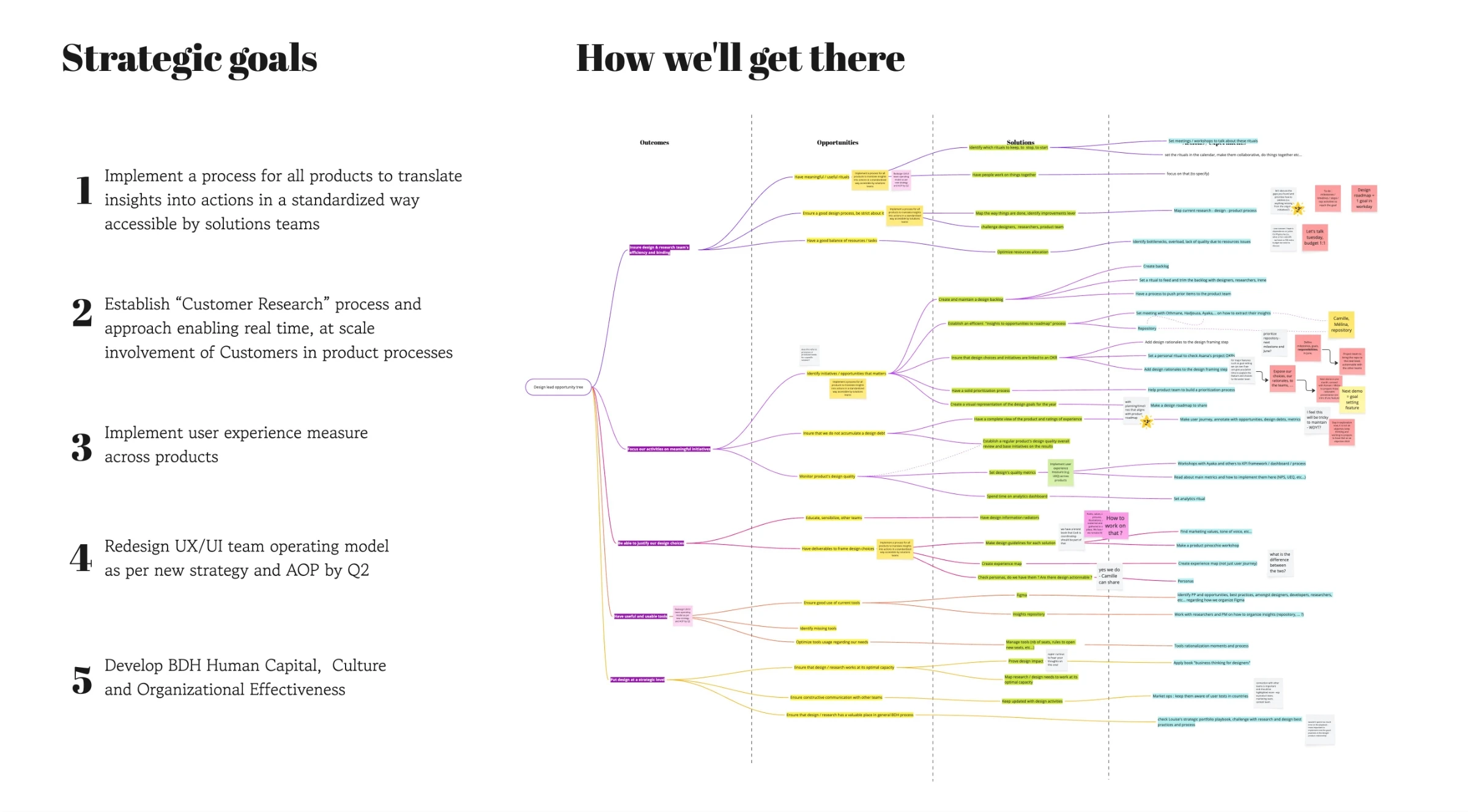
I then structured our response to those goals through an Opportunity Solution Tree—a reference framework normally used to frame a product, applied here to the Product Design function itself. Each goal broke down into outcomes, opportunities, solutions and concrete actions: team rituals, resource allocation, prioritisation processes, tool governance and Design quality measurement.
Most of this plan was implemented over the following two years. The next three chapters are its most visible branches.
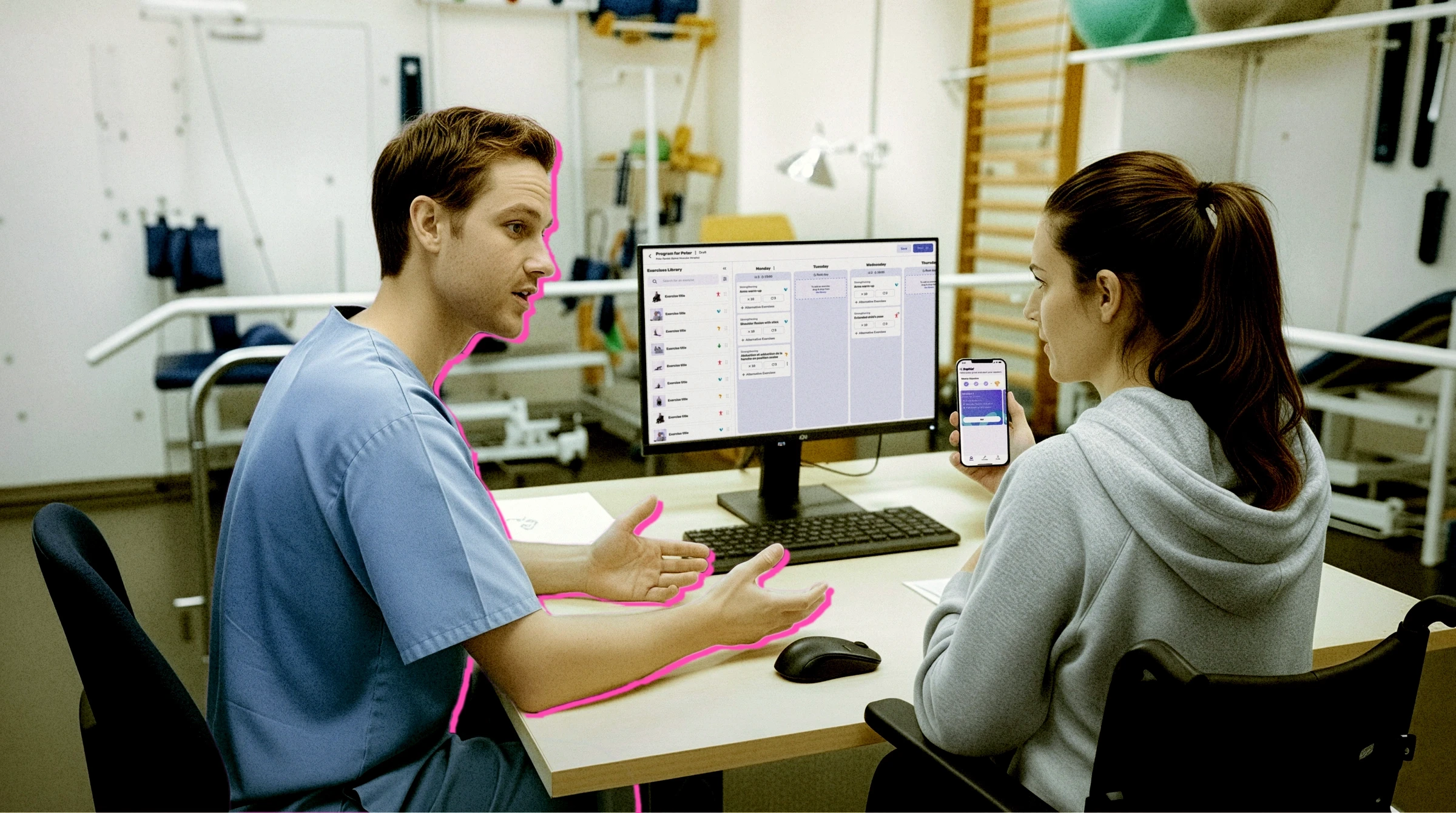
Depoliticise product decisions
One of the plan’s priorities was to focus the team on the initiatives that genuinely mattered. When I arrived, roadmap decisions were being made through informal consensus and whoever had the strongest voice.
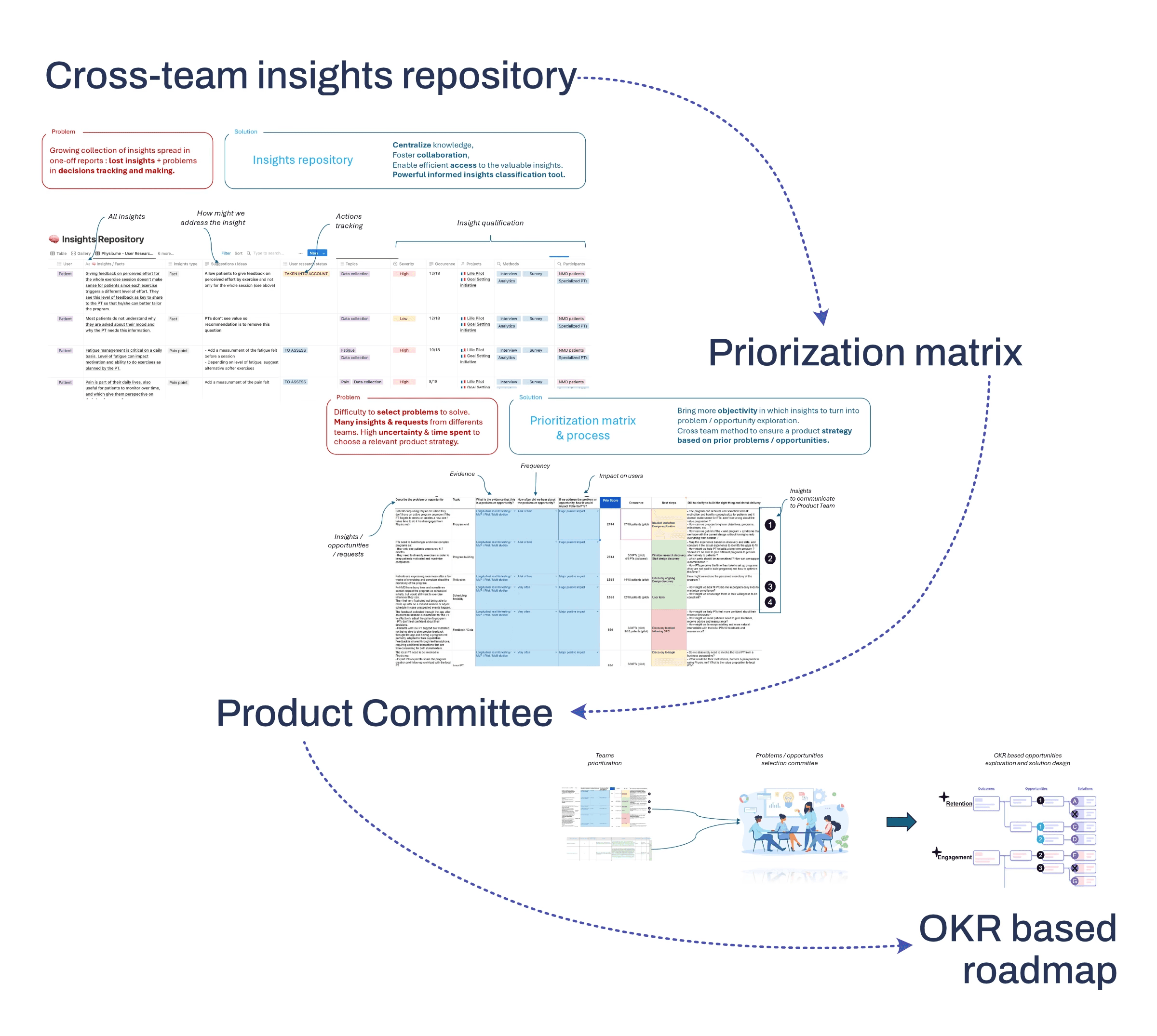
Zsuzsanna Varga, Head of Product, and I took the time to co-design with the teams a four-step decision chain:
an Insights Repository centralising field feedback : severity, frequency, patient and therapist verbatims;
an Opportunity Canvas inspired by Marty Cagan / GitLab standards to frame every opportunity before investment;
a prioritisation matrix calculating a multi-criteria score across evidence, frequency and impact;
systematic alignment with retention and engagement OKRs.
Sustained change work drove adoption of the system and brought political trade-offs to an end: every roadmap priority became traceable to field evidence or a quantified business objective, rather than opinion.
Its real value was to decouple the quality of a decision from the size of the team making it, and introduce an evidence-driven process into product choices.
On Physio.me, our flagship product, this system led to a major strategic reframe.
Patients felt abandoned whenever a programme ended, while therapists lost critical time rebuilding everything from scratch. After a series of external interviews and a deliberate challenge to internal assumptions, we modelled the key cause clearly: therapists thought in 6–8 week reassessment cycles, not in completed programmes.
That changed the entire Design question. Instead of “How do we manage the end of a programme?”, we reopened it as: “How do we create continuous engagement, punctuated by checkpoints?”
We then formalised five guiding principles so future trade-offs could be made without reopening the same debate every time.

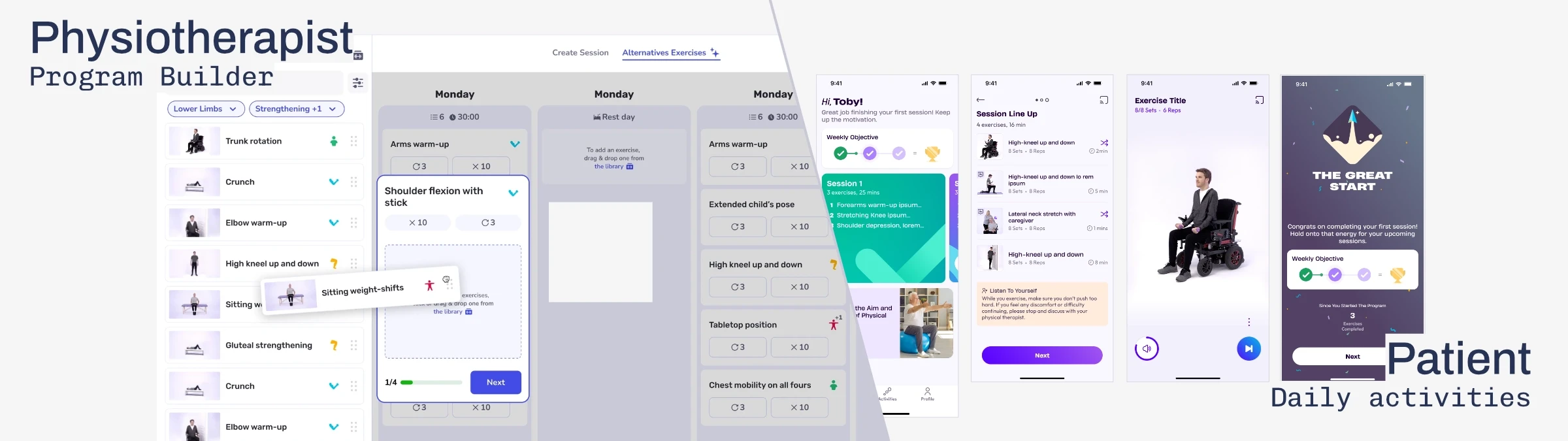
That framing guided several workstreams run in parallel by the team, including redesigning exercise assignment through the programme builder, creating an engagement strategy, increasing the variety of patient exercises and opening complementary content for patient acquisition.
Build product culture
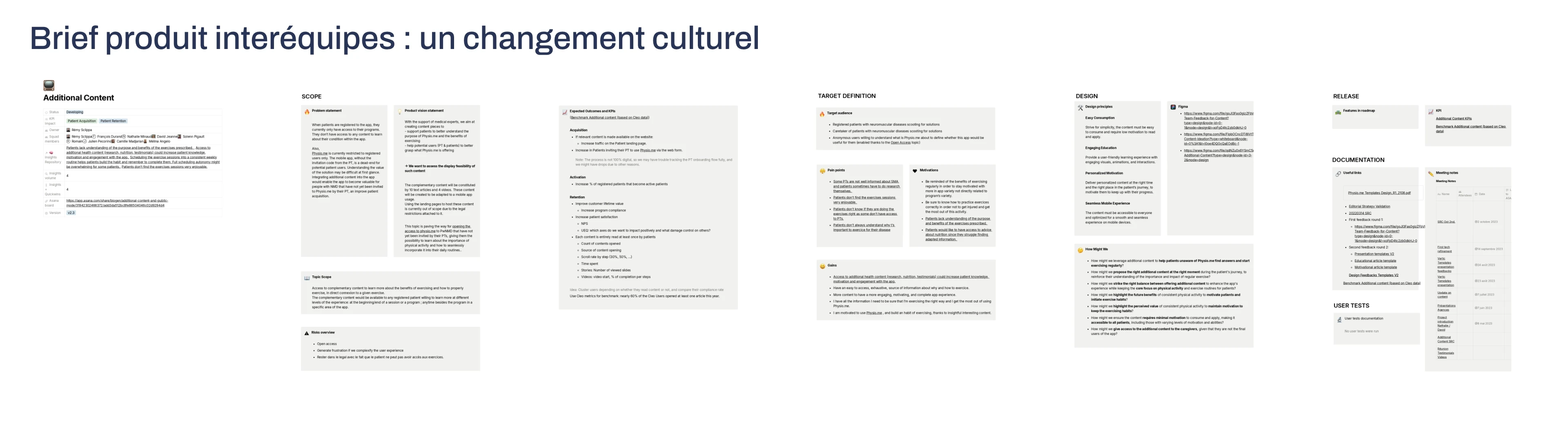
The lack of a shared vision and siloed ways of working were leading to arbitrary choices and fragmented decision-making, slowing the product down. To address this, we brought the teams together around an iterative co-design process focused on how we worked.
Starting from a prototype “Product Brief” that everyone could make their own, we allowed it to evolve organically until it established itself as a powerful lever for agility: the Feature Blueprint, our single source of truth.
By bringing the problem statement, key metrics, research and monitoring, working resources, and decision traceability together in one place, the document became the product’s working memory. It rationalised Design decisions and product team choices more broadly, while ensuring continuous cross-functional alignment.
The cultural shift created by this tool enabled sustained operational and strategic alignment.
This documentation discipline locked the bridge between Discovery and Delivery into place, where the handover between our teams had previously been one of the most frequent points of failure.
The format became the standard across Product initiatives: a more sustainable impact than any individual feature we shipped.
Lead under constraint
The final pillar of the plan (developing the department’s human capital and organisational effectiveness) took on an entirely different meaning in the face of budget constraints and the closure of the department.
I had been hired on the expectation of 15 designers and researchers supporting six products. By the time I started, the new CEO’s budget cuts had reduced that to two designers (Julien Pecorino and Rémy Sclippa, two Product Design virtuosos) and two researchers, the wonderful Camille Madjarian and Mélina Angelo. They became my core team for covering the entire portfolio. The closure of the department was announced shortly afterwards.
We focused our active delivery capacity on two products: Physio.me and Phoebe, a personalised and shared monitoring service for spinal muscular atrophy.
We maintained a monthly health check on Cleo, supporting people with multiple sclerosis; Neurodiem, a scientific information service for neurologists; and Konectom, an at-home neurofunctional testing application, without committing meaningful Design capacity to them. In parallel, we framed the strategy for Luna, a companion for people living with lupus.
We established regular rituals, Design critiques, retrospectives and cross-functional workshops. I also proactively connected with other Biogen teams globally to share methods and create useful synergies.
As our solutions were being sold as part of the department’s closure, this allowed us to maintain and improve the quality of our products, ultimately increasing their value in the sale for Biogen. So was our, successful, strategy.
I treated the Design function like any other product: frame it, test measurable hypotheses, iterate, and be willing to be wrong fast.
Ultimately
Two years later, the Digital Health department was closed, classified as being outside Biogen’s core pharmaceutical business alongside several other departments considered non-essential to drug development.
In the months leading up to the closure, while we trained the organisations taking over our products and methods, every member of the Design & Research team received a job offer from them, explicitly recognising the cultural and operational excellence we had built together.
Until the final day, the team came to work with the pleasure of being part of that culture.
Postscript
On Physio.me, we spent months understanding why a programme ending can betray the person it is supposed to support, and building continuous engagement instead.
It took me longer to realise how much the same idea had shaped everything else. I didn’t want a team reduced to four people to feel abandoned between two budget crises either. The rituals, briefs and weekly check-ins were not just governance. They were the same conviction, applied to ourselves.
It is probably no coincidence that this product, working on these particular diseases, affected me so strongly. I had studied neurophysiology and pharmacology before moving towards neuroscience applied to Design, and working with patients living with neuromuscular diseases brought me back to a part of myself I thought I had left behind.
Designing an organisation that can make decisions with greater confidence and impact.
Open to a permanent role
If your organisation needs to turn evidence into decisions and culture into impact, let’s talk.