
DESIGN LEADERSHIP & OPERATIONS
·
E-COMMERCE
Strengthening Design beyond the Design team.
At ManoMano, I turned fragmented practices into a shared operating framework connecting four designers, eight B2C Feature Teams and their Product, Tech and Business partners.
In short
I joined ManoMano in 2021 to lead Design for the B2C experience (Commerce, Projects & Services, essentially what customers experience on manomano.fr) during a strategic restructuring that weakened the Design organisation.
Product, Tech and Design were being separated, Design moved under Marketing, and the Design organisation lost two thirds of its headcount within weeks.
Across eight Feature Teams and with four designers, I inherited diffuse Product decisions, an unreadable roadmap and team rituals that were fading out.
I built a seven-step Product Design framework connected to SAFe PI Planning, rebuilt the governance of team rituals, and distributed ownership to Design leads across key workstreams. The system was supported by a scored backlog (value, effort, confidence), a reconstructed roadmap and a post-launch monitoring loop.
In seven months, B2C CES increased +545 basis points year-on-year, from 62.1 → 67.5, above the quarterly target of +240 bps, with a team that never lowered its standards despite the context.
Rebuild team rituals before they fade out
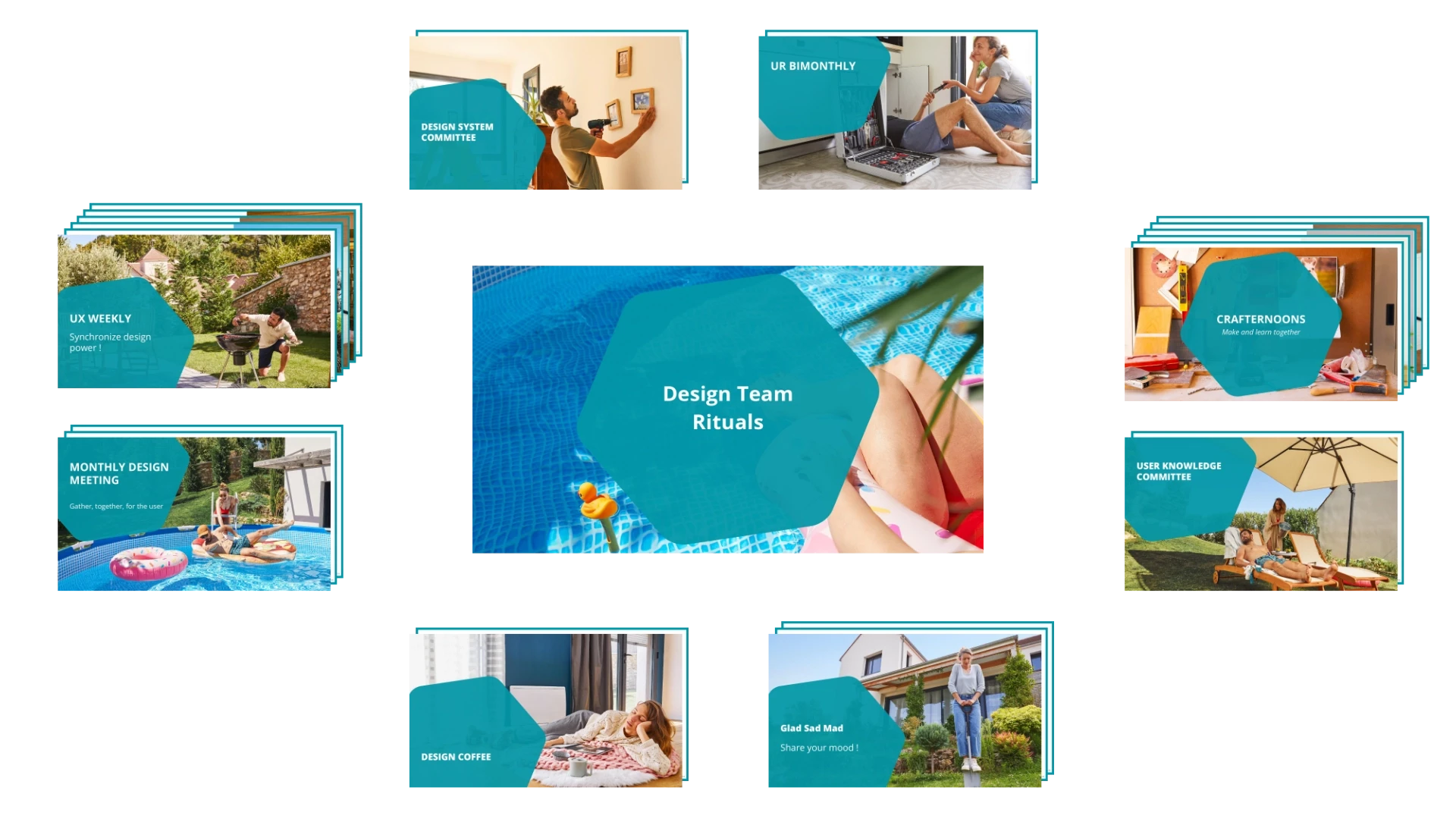
When I arrived, most of the Design & Research team rituals (weekly, monthly, Crafternoons) were fading: poorly attended, loosely structured and no longer playing a meaningful role in the team’s collective dynamic.
Together with Florence Jop, the senior Design Researcher who joined at the same time as I did, we put those rituals back on the table across all three levels of the Design organisation: our Head of Design, the irreplaceable Sophie Muto; the two Senior Leads, including the brilliant Emmanuelle Blanck; and the designers and researchers themselves.
All 20 people took part in redesigning them.
We gave each ritual a clear and complementary purpose:
UX Weekly for cross-team visibility and peer Design critique;
Monthly Design Meeting for strategic alignment with our Head of Design and CES/NPS tracking;
Crafternoons and Design Coffee for team cohesion and psychological safety.
The change that had the greatest effect was introducing rotating owners for most rituals instead of fixed facilitation.
Each person would, in turn, prepare the agenda, run the session and keep the record, turning rituals people attended into rituals the team collectively owned.
Build a shared roadmap and process
My team operated as a cross-functional Design group embedded across eight Feature Teams covering the entire B2C journey—from customer advice and Product discovery to services, checkout and user-generated content.
And my formidable team, the demanding Product Designers I had such a good time working with, was Gary Delporte, Charlie Garaude, Cyril Mathieu and Mélany Caulet.
Before I arrived, the Design roadmap had no shared structure or stable format, and the team was spending too much time constantly reinventing how it organised itself.
I first took time to understand how the team worked, then tested several systems, tools and formats before arriving at an organisation and roadmap that could be read at a glance—both a progress-tracking system and a prioritisation tool shared with Product and Tech.
Ahead of each SAFe PI Planning cycle, I orchestrated the collection and assessment of Design and Business hypotheses into a scored backlog with the team—user value, effort and confidence—informed by CES, Product data and field feedback.
Each topic across every Feature Team then followed the same seven-step process, from strategic framing to post-launch monitoring, ensuring methodological consistency despite the diversity of the work.
On the ManoMano product quality/value ranking initiative—MD Ranking—this framework allowed us to hold a schedule of four two-week cycles, from framing to production, without bypassing the method.

At the request of peers in other companies, I documented how I had co-designed the process with Product, Tech, Business and Design teams and published it in an article on Medium.
Methodological rigour only holds if the team carrying it is well managed every day: weekly 1:1s, individual growth plans, training, and a leadership approach adapted to each person.
I have led Design teams since 2010, from co-founding Brain Candy, a video game studio of up to ten people, and managing eight ergonomics designers at PSA, to the designers and researchers at Biogen Digital Health, Netwo and Manomano.
Along the way came extensive training and several periods building Burning Man in the Nevada desert with teams working under extreme conditions. A leadership school in its own right.
Turn user insights into decision evidence
On the equipment installation journeys workstream, research revealed that installation complexity, not price, was the real barrier to online purchase in technical categories. We therefore ortiented the design tactic towards an integrated product + installation journey, bringing partners such as Homeserve, FrizBiz and HomeLife directly into checkout.
On Product and search-result page, analytics were showing high rebound rate on the product page & a competitive benchmark guided us toward the solution : the one and only template we were using could not serve both technical categories (where people needed information and reassurance) and décor categories(where they needed inspiration and projection). That evidence allowed us to make the strategic choice to design several templates by Product family in order to end the jack-of-all-trade tactic that was in place at that time.
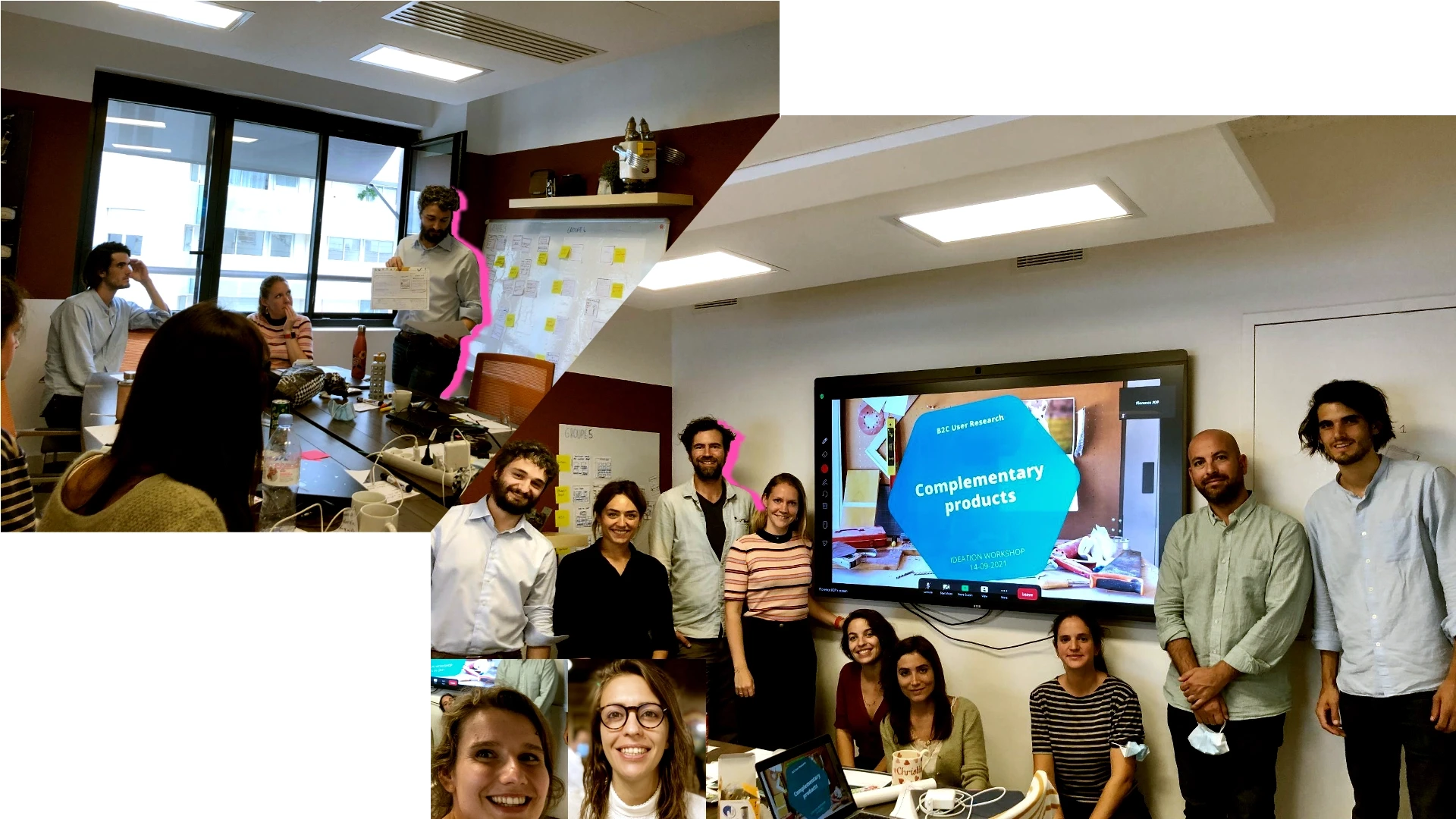
To establish the benchmarking method, we brought the designers together for three hours to share practices and lessons from previous experiences. The work was substantial enough that I later turned it into another Medium article, which received more than 3,000 views and was shared in internal Slack channels at other companies.

Sur la recherche, alors que 40 % des utilisateurs abandonnaient leur session sans convertir après une requête, avec mon équipe nous avons porté une vision où la recherche cesse d’être un simple outil d’extraction produit pour devenir un accompagnateur de projet.
Lay the foundations for a shared Design language
In strategic partnership with the company’s DesignOps lead, Luca de Battista, I co-led the initialisation of ManoMano’s Design System: a shared component foundation in Figma, the first Storybook experiments as a bridge to Tech, and simple, opinionated Design principles to eliminate accumulated debt across existing journeys.
I led this work at squad level to define who owned what, how other Feature Teams would adopt components, and how the shared foundation could free Design time for higher-value decisions.
When everything shakes, design rigor rests on a team that holds its standard."
Ultimately
In a year, B2C Design moved from a function weakened by an unfavourable restructuring to a system that could hold at scale: team rituals restored and collectively owned, a roadmap and process documented and adopted beyond my immediate scope, a portfolio of eight Feature Teams governed coherently, and CES improving above target across most markets.
Postscript
What this story does not convey enough is how personally difficult it was.
E-commerce has its own language, numbers, commercial mechanics and internal acronyms, and I often found myself in conversations I simply did not understand well enough.
It was hard. A lesson in humility for a designer who thought he already understood Business.
That confrontation was a major reason I later enrolled in the d.MBA. A Head of Design cannot afford to stay outside the numbers and commercial mechanisms they are expected to influence. They need to be able to sit at the table and understand what is being discussed, not only contribute to the experience that comes out of it.
Strengthening Design beyond the Design team.
Open to a permanent role
If your organisation needs to strengthen Design in a shifting environment, let’s talk.