
SYSTEMIC DESIGN & INNOVATION STRATEGY
·
PUBLIC SECTOR
Giving craftspeople back the power to make with passion.
MateriA connects materials, services and local ecosystems to give craftspeople back time, resources and choice.
In short
The French Directorate-General for Enterprise (DGE), part of the Ministry of the Economy and Finance, commissioned the project with ENSCI-Les Ateliers, a leading French design school.
The brief was to “bring craft and industry closer together to support French reindustrialisation”.
We could have designed a better sourcing service for craftspeople. Instead, our systemic Design approach led us to intervene at a broader level: the relationships between those who make, those who supply, those who finance and those who shape local economies.
We first turned an open-ended policy brief into a precise systemic problem through two funnel-shaped phases of exploratory research. We then designed MateriA, a place-based infrastructure reconnecting materials, know-how, industry and local authorities.
The project is now a quantified business and territorial model, with an identified site, a four-milestone roadmap and a path towards national rollout.
Reframe the brief
The Ministry’s request was to rethink the relationship between craft and industry: support sustainable sourcing, strengthen French production and recognise craftspeople as key actors in that process.
But the brief already contained too many implied solutions. So we reframed it around one simple, strong motto:
“Help craftspeople keep practising their craft for the long term, with passion, by making sourcing easier.”
We were a tireless, meticulous team of five Strategic Designers: Abelia Becker, Weame Momtaz, Stéphane Kouamé, Pierre Denat and me.
Starting with historical analysis and comparisons with other countries, we explored the tangible and intangible flows between craft and industry, highlighting craft know-how as a strategic resource for industry.
We then narrowed the investigation to France through desk research, government reports and interviews with numerous proxies across craft and industry (trade chambers, fab labs, intermediaries and third places).
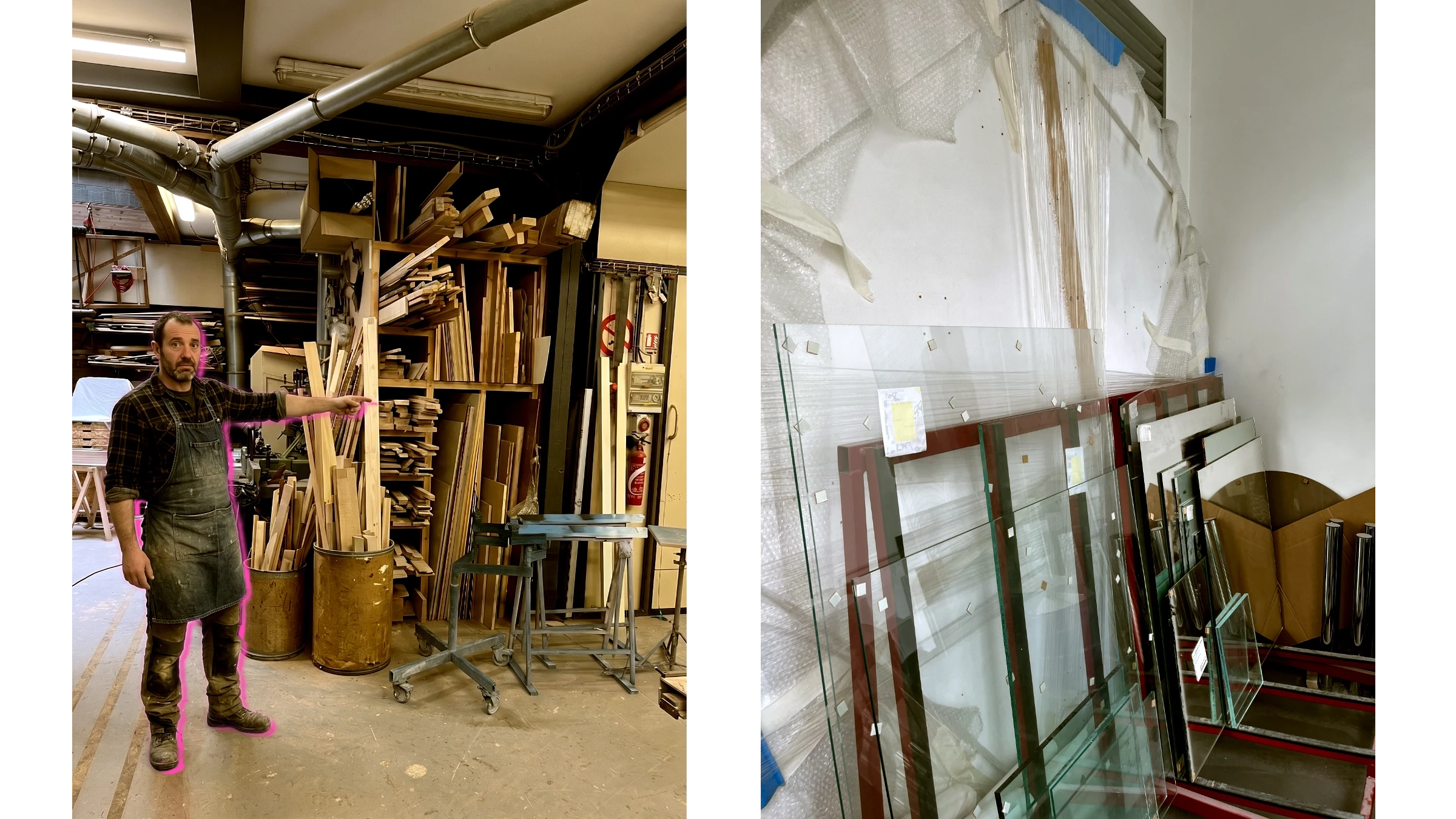
Then came direct immersion: 15 craftspeople observed in their workshops (glassmakers, gilders, upholsterers, cabinetmakers, masons, jewellers, metalworkers and others) more than 50 photographs, over 15 hours of interviews and 3,665 tagged research excerpts.

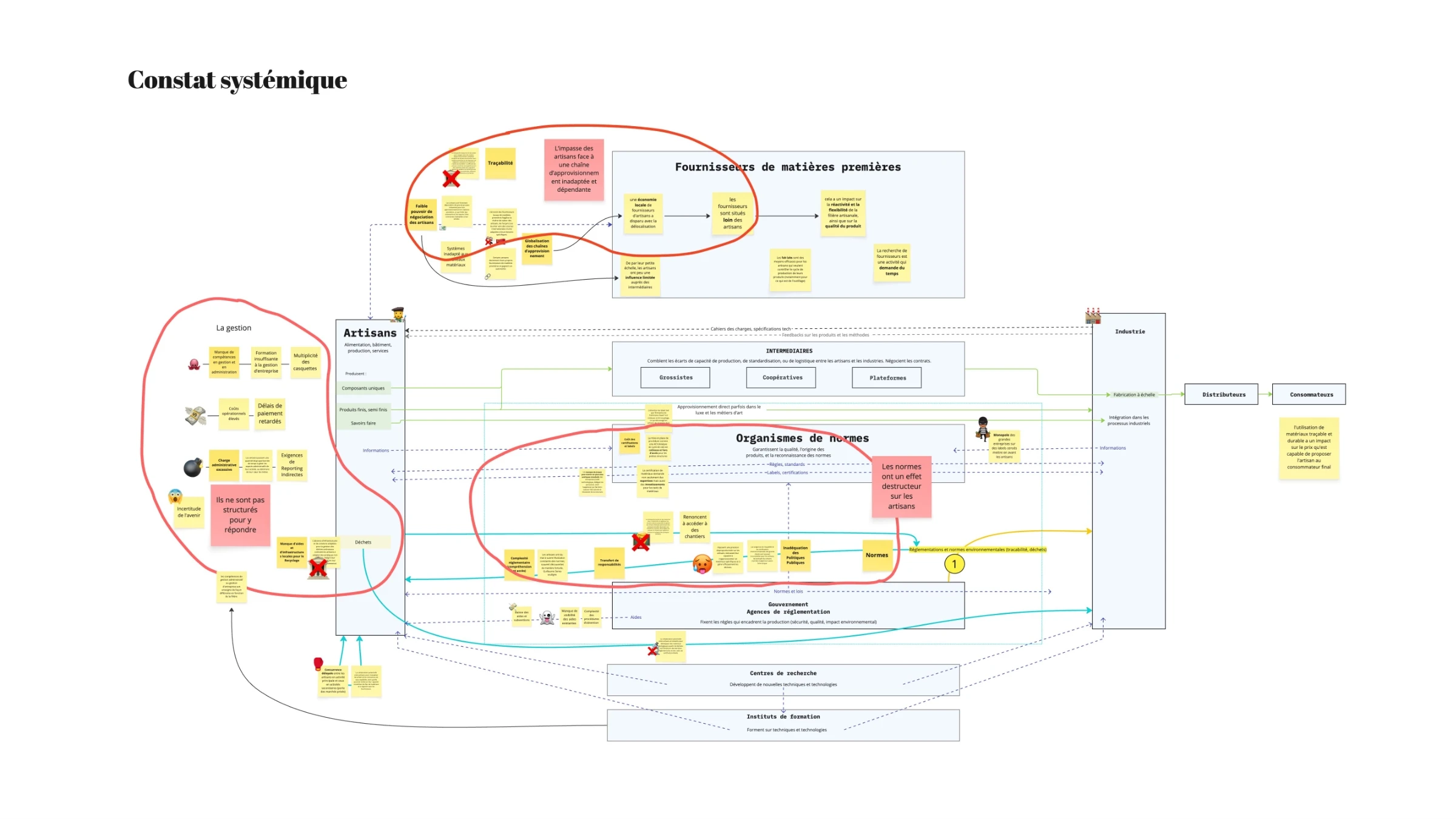
Three systemic asymmetries explained why the system was failing:
Regulatory asymmetry: requirements were increasing faster than small businesses could absorb them.
Material asymmetry: supply flows were designed at industrial scale, while craft needs were fragmented, local and variable.
Capacity asymmetry: craftspeople were carrying growing responsibilities without the corresponding time, skills or resources.
Structure field evidence
The picture was concerning. We needed to identify where in the system an intervention could have the greatest impact. We:
consolidated thousands of raw research observations into 46 structured problem statements using the format “When [context], I want [goal], but [obstacle] because [reason], which makes me feel [emotion]”;
built a systemic map of the topic;
positioned and weighted those problem statements on the map to make the system’s pressure points visible.

That mapped hierarchy became the foundation for every decision that followed, starting with where an intervention could shift the greatest number of variables.
Decide where to intervene
From a new craft guild to a craftsperson–supplier intermediary, we generated eight strategic directions offering different ways to redistribute roles, resources and flows between craft and industry.
Each was benchmarked against existing models (LUMA, Réserve des Arts, CIAV, Cycle Up) and tested against the others over several iterations.
Three sets of criteria guided the decision:
economic viability;
ability to address structural frictions;
potential for national replication.
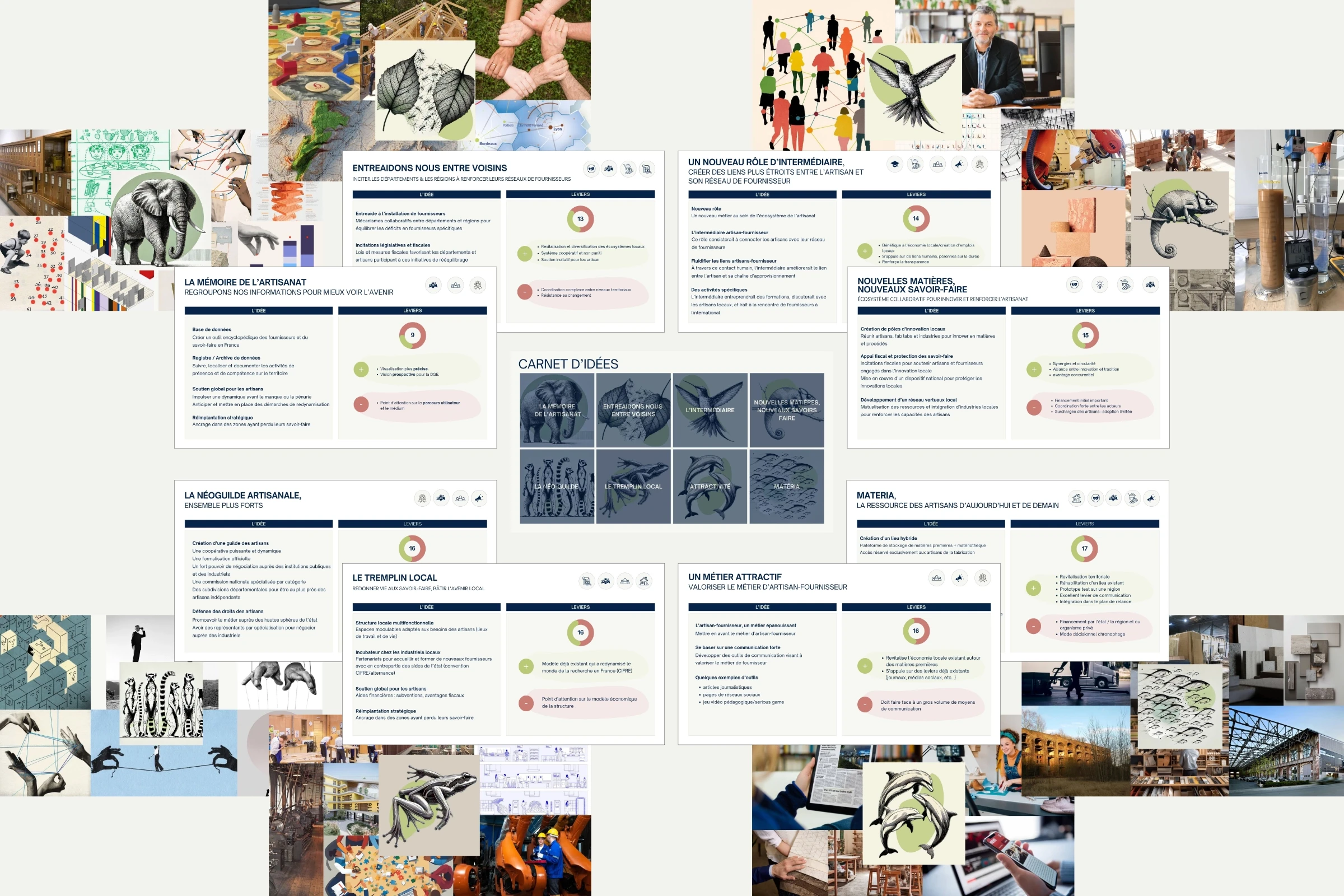
Through successive iterations between the Ministry and the field, one direction became increasingly convincing: MateriA, a place for synergies designed to improve craftspeople’s production cycle, give them access to raw materials at negotiated prices, and simplify administrative work so they could focus on what matters most:
MAKE, TOGETHER.
Ground the model in reality
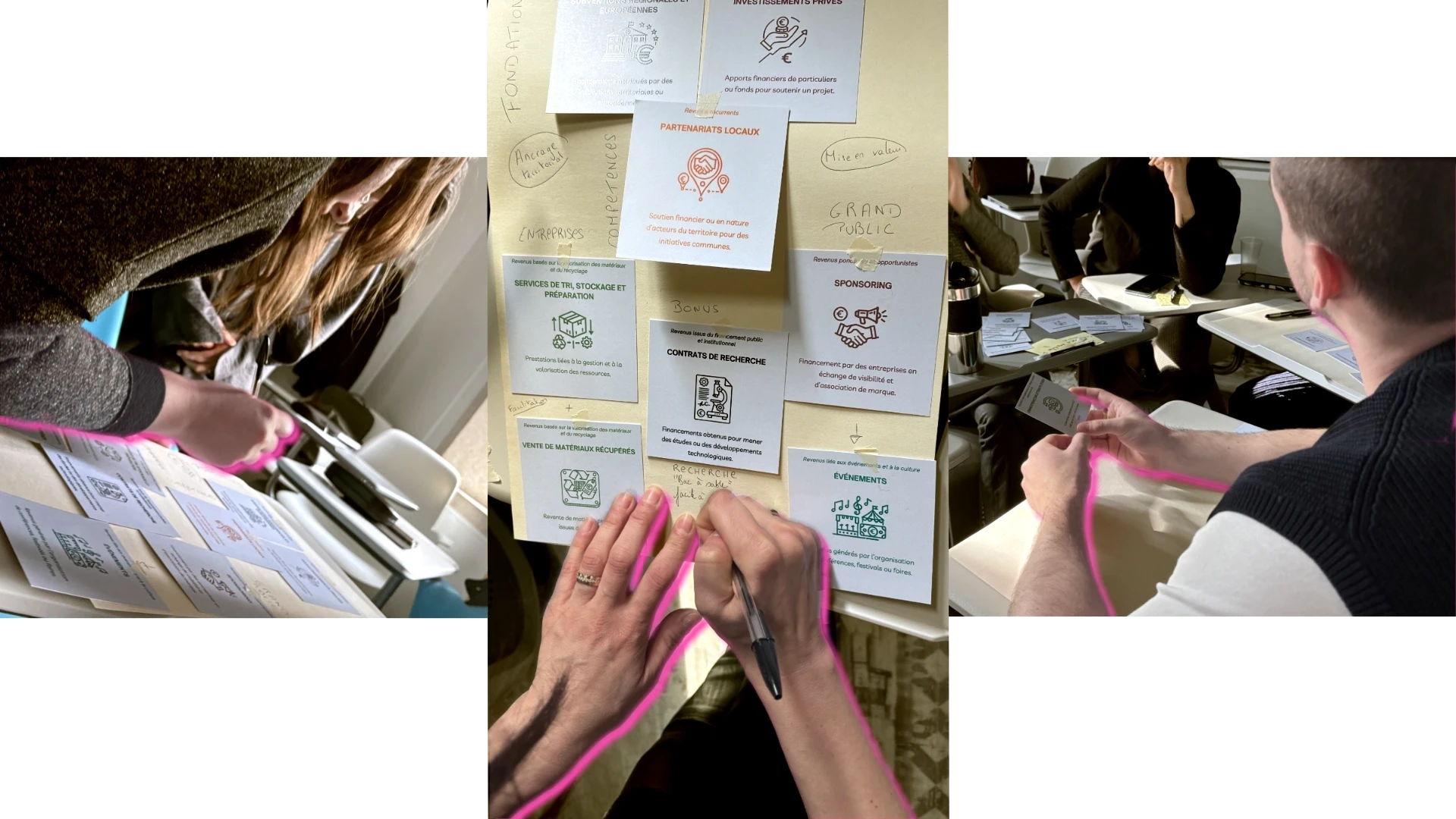
To make the project viable, I applied models from the d.MBA (a 6 weeks MBA program for designers) to co-design MateriA’s business model with the French Ministry of the Economy and Finance.
We then mapped the impact of the model across the entire ecosystem (craftspeople, industry, local authorities and cultural partners) alongside the financial and non-financial flows connecting them, to understand what each actor could contribute, receive and redistribute across the system.
This is where connecting experience, decision-making and value creation makes Design strategic.
We spent several iterations refining the economic model until we had a realistic P&L: €1.2M CAPEX, €1.38M OPEX and €1.75M projected revenue, supported by three subscription models : "Synergie", "Matières" and "Présence".
The business model was developed jointly by designers and Ministry decision-makers.

Make the local scale a Design variable
Once the model was clear, the local scale itself became the next Design variable to make concrete.
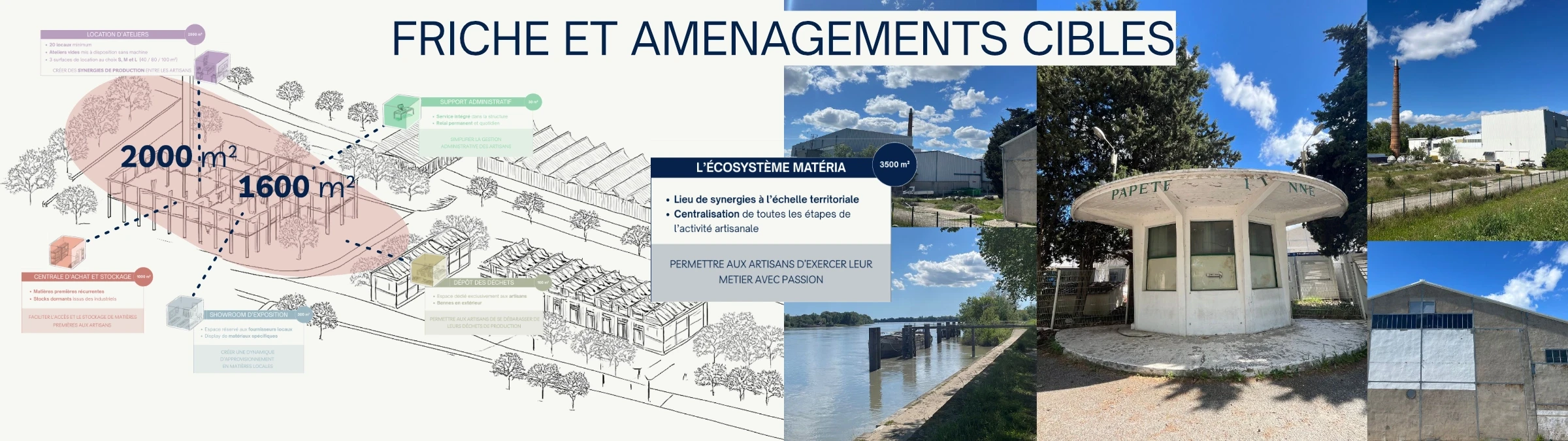
Our research led us to the former Papeteries Étienne industrial site in Arles: 3,600 m² available, river access, an area undergoing regeneration, and proximity to a network of craftspeople and industrial businesses.
Finally, to make MateriA a reproducible place-based unit, we designed a four-milestone trajectory moving from the Arles pilot to a network of three MateriA sites within five years, then five within ten years, progressively testing the conditions required to replicate the model.
Beyond products, services and experiences,
I design the conditions that let people act with full agency.
Ultimately
Working as systemic designers through ENSCI-Les Ateliers for the French Directorate-General for Enterprise, we turned the policy intent “reindustrialise France by creating stronger synergies between craft and industry” into an operational asset: an identified site, a P&L and a deployment roadmap.
We gave the DGE a way to turn its strategy into execution.
MateriA creates value at five levels:
for craftspeople, by giving them back control, time and capacity to act;
for organisations, by turning fragmented needs into a viable economic model;
for the ecosystem, by orchestrating new relationships between craftspeople, industry and local authorities;
for the local area, by activating a site and local resources;
and for industrial policy, by turning it into a replicable system.
Beyond the services it provides to craftspeople and industry, MateriA creates value through the capabilities it redistributes across the local ecosystem: buying, making, cooperating and deciding.
Its real test will ultimately be whether it creates autonomy and helps revitalise the area by enabling craftspeople to practise their craft for the long term, and with passion.
Postscript
The spreadsheet: an unexpected Design tool…
Spending long days inside CAPEX and OPEX lines may sound counter-intuitive for a designer. Yet this is where I learned the most.
The Excel spreadsheet became a Design tool, and cost became a Design variable in its own right.
Until then, I had tended to see economic constraints as something that reduced, or even killed, a project. Here, they gave the project its form, to the point where we could hand the Ministry a realistic roadmap.
A systemic Design project cannot simply be desirable. It also has to be governable, fundable and transferable into operational implementation.
Giving craftspeople back the power to make with passion.
Open to a permanent role
If your organisation needs to turn a systemic intent into an operational asset, let’s talk.