
RESEARCH THROUGH DESIGN & EDITORIAL DIRECTION
·
I built the tools Design needs for the transformation economy
Research conducted at ENSCI became a new Design paradigm, a four-part method and a 290-page playbook helping designers create experiences that can support lasting human transformation.

In short
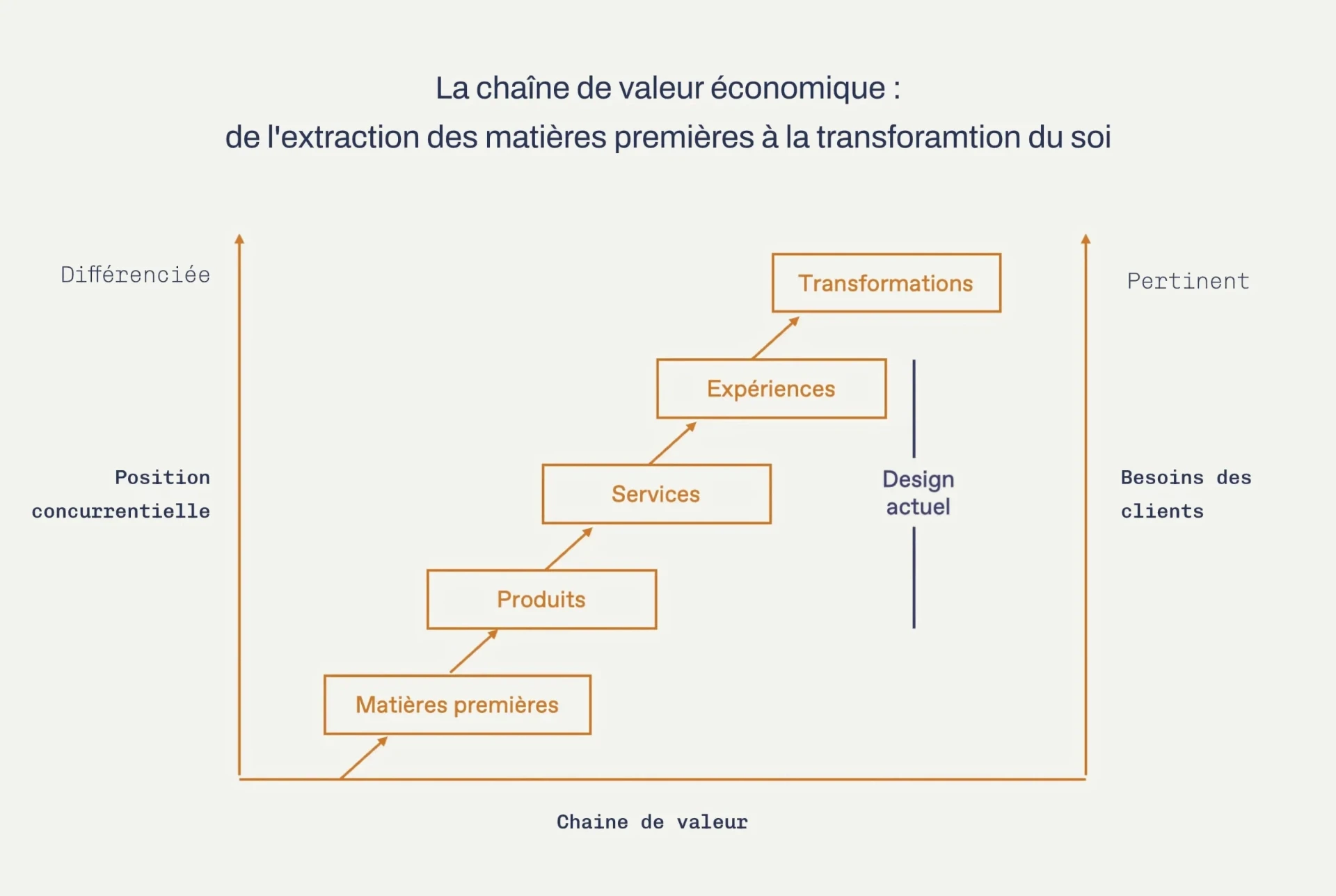
In The Experience Economy, Pine and Gilmore described a progression in economic value: commodities, products, services, experiences—and ultimately personal transformation.
Design has developed mature ways of working across products, services and experiences. But when organisations promise lasting changes in how people see themselves, behave or act, our discipline has far fewer methods for designing responsibly towards that outcome.
I made that blind spot the subject of my professional thesis at ENSCI-Les Ateliers, as part of the Mastère Spécialisé Sustainable Innovation by Design.
After two years of intensive research built on a much older field of observation (including twelve years spent around transformative and ritual communities such as Burning Man) I developed an interdisciplinary body of knowledge, challenged it with international researchers, and turned it into a complete practice framework: Transformative Experience Design.
It addresses one question:
How can we design good products and services that also create the conditions for people to genuinely change?
The paradigm takes the form of a four-part method, a six-phase Transformative Journey and an ethical doctrine.
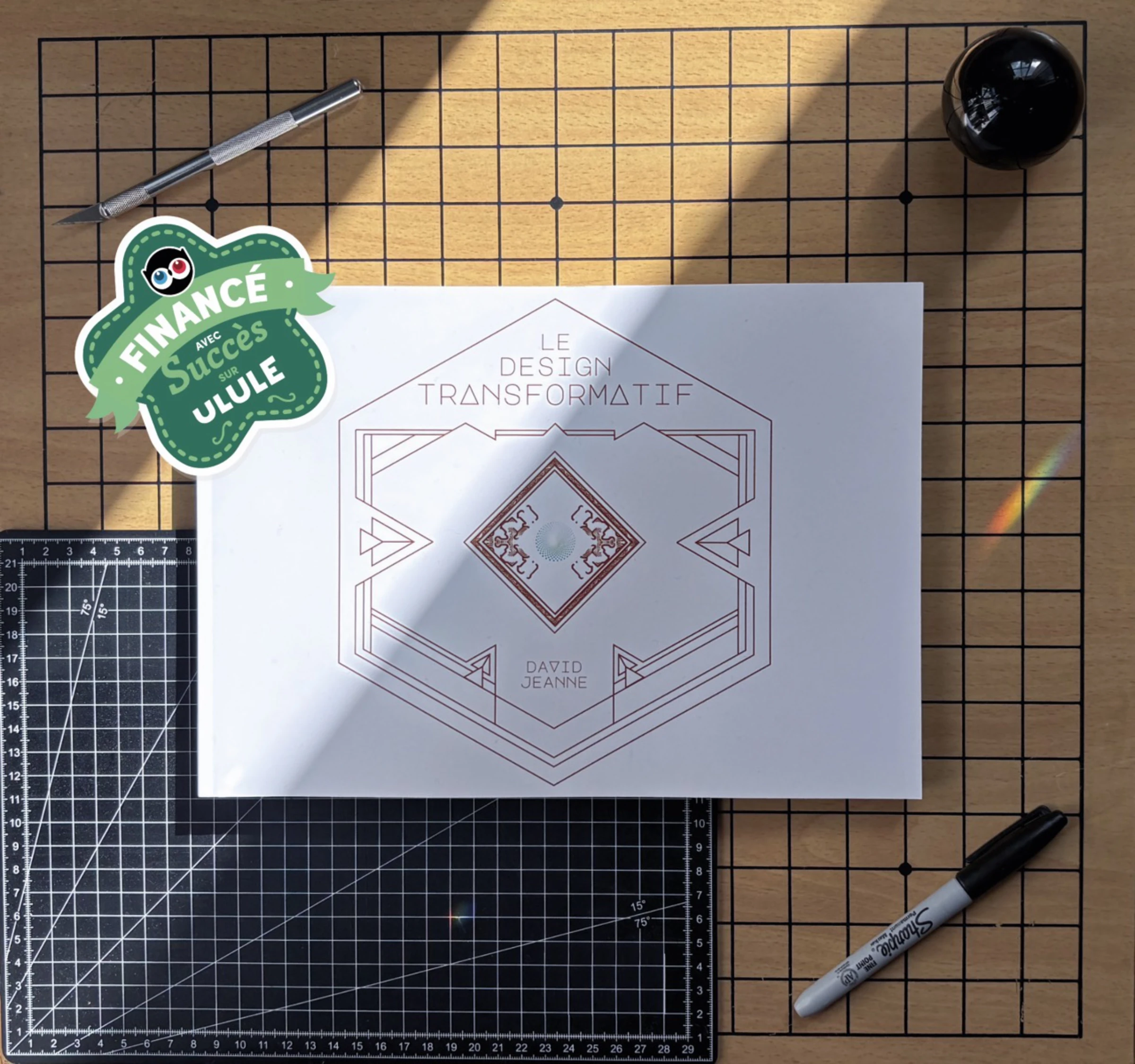
To move it quickly beyond academic circles and into designers’ hands, I turned it into a complete editorial product: The Transformative Design Playbook, 290 pages that I designed, prototyped, edited, financed through crowdfunding, printed and distributed myself.
The pre-order campaign sold 270 copies in six weeks.
A complete Design project, from idea to distribution, contributing to both Design practice and Business.
Name the blind spot
Pine and Gilmore described a progression in economic value: as markets mature and become commoditised, differentiation moves upward : from commodities to products, products to services, and services to experiences.
At each transition, Design expanded its practice and built the tools required to support it.
For more than twenty years, Pine and Gilmore have argued that a fifth economic layer is emerging: one in which an experience, sufficiently personalised and sustained over time, can ultimately create lasting change in the person themselves.
The metric is no longer simply time well spent, but time well invested in oneself.
On this territory, Design still lacks vocabulary, methods and safeguards : we know how to make a journey useful, enjoyable and desirable. We know how to reduce friction and improve conversion.
But beyond a well-functioning experience, what is the lasting human effect and how can we approach it with method and rigour?
Without an appropriate framework, transformation remains a fortunate side effect rather than an explicit Design intention.
Over twenty years of Product Design, strategy and leadership, I have watched our discipline mature. If that mastery remains essential, it has also increasingly become a baseline expectation. In parallel, for twelve years I experienced deliberately transformative environments from the inside, including ten Burning Man participations, where I am part of the build crew. During those, my designer’s eye kept observing, analysing and accumulating questions that eventually became the basis of this work.
My starting hypothesis was simple: if certain settings repeatedly support these kinds of shifts, their Design conditions should be understandable.
How can Design intentionally support transformative experiences?
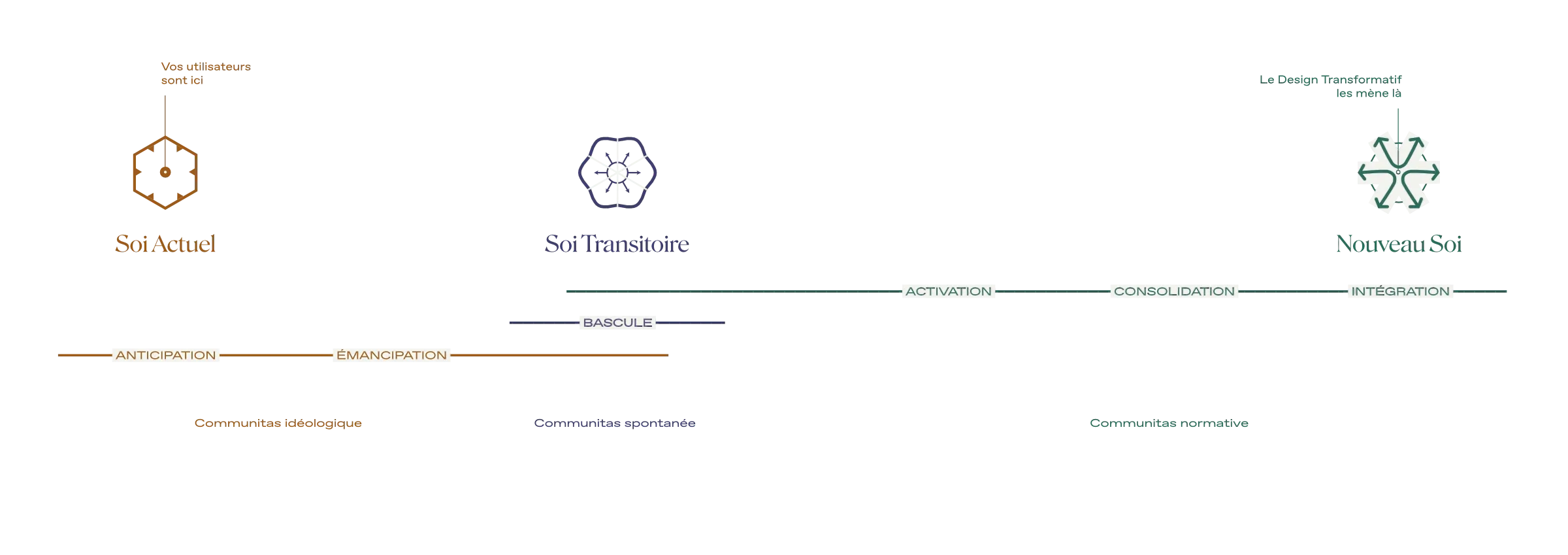
Take Strava. One potential persona starts from: “I’d like to exercise, but I can never seem to make it stick.”
The Playbook provides an approach for designing towards a possible future identity: “I now see myself as an athlete.”
Product Design, Service Design and Experience Design did not yet provide a clear way to name or work with this material. Transformative Experience Design adds another depth of intervention and a method for designing the passage without pretending that inner transformation can be programmed.
Make the theory actionable
To prevent Transformative Design from remaining an inspiring but impractical concept, I built a complete method documented across 140 of the Playbook’s 290 pages, with the same practical and didactic ambition as the major Design methodology books that shaped my own practice.
01 Understand the Current Self : Exploratory research moves beyond conventional needs, motivations and pain points to map identity scripts, crystallising contexts and loss of meaning.
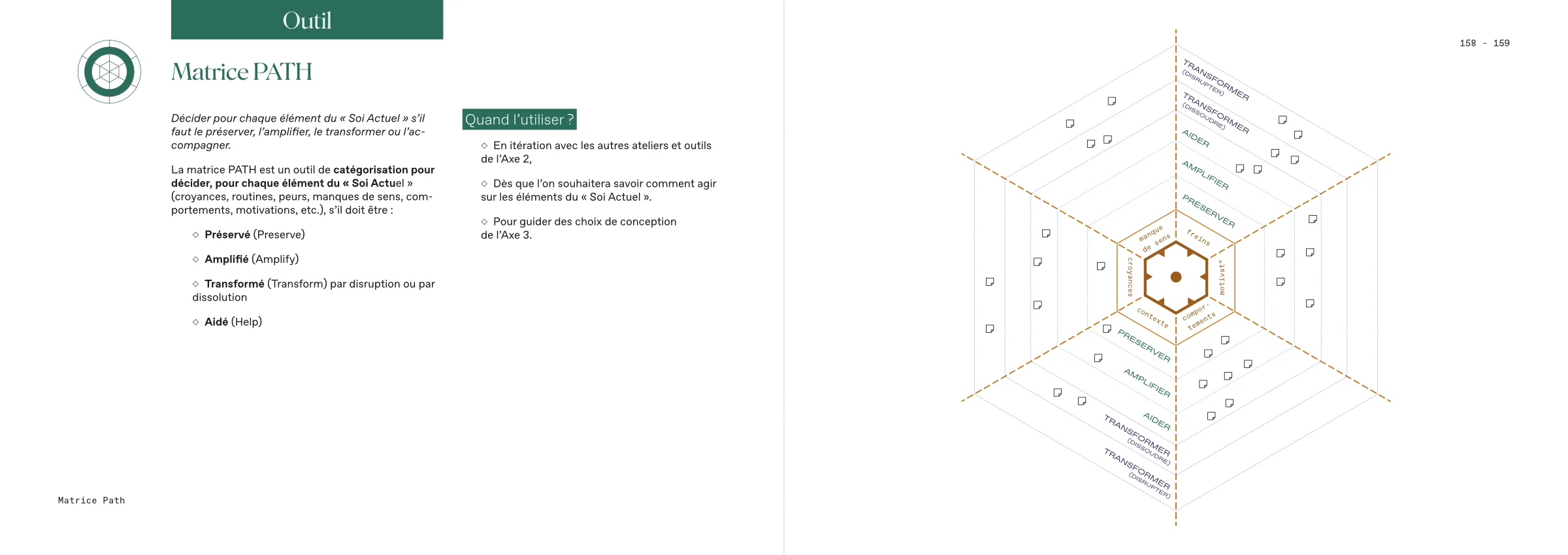
02 Define a Transformational Horizon The Transformational Question and PATH matrix (Preserve, Activate, Transform, Help) force a team to turn a generous but vague intention into explicit choices, without ever prescribing a “better human”.
03 Design the passage: through the Guidance Archetypes and a six-phase Transformative Journey (Anticipation, Emancipation, Liminal Passage, Enhancement, Afterglow, Identity Reconciliation) the method makes visible what conventional UX journeys tend to leave out:
the before that prepares;
the liminal in-between that destabilises through a disorienting dilemma;
and the after that helps the transformation hold.
04 Evaluate the shift: a measurement architecture combines phenomenological and psychometric measures across three time horizons, avoiding the confusion between emotional intensity and genuine transformation.
The system can be audited against seven explicit criteria, allowing a third party to recognise, or challenge, a Transformative Experience Design project.
Build a field of knowledge
The subject had been developing for years, but the decisive shift came through two years of intensive work at ENSCI, preceded by earlier exploration: years of thinking about the question, then a conference on lessons from Burning Man that forced me to articulate the first conceptual building blocks.
The phenomenon I wanted to equip was scattered across several disciplines.
I built a corpus of fifty academic papers and books, connecting:
anthropology: rites of passage, liminality, communitas;
psychology: transformative cognition, accommodation, eudaimonic emotions;
philosophy: lived experience, pragmatism;
Design research: Emotional Design, Liminal Design and Transformative Experience Design.
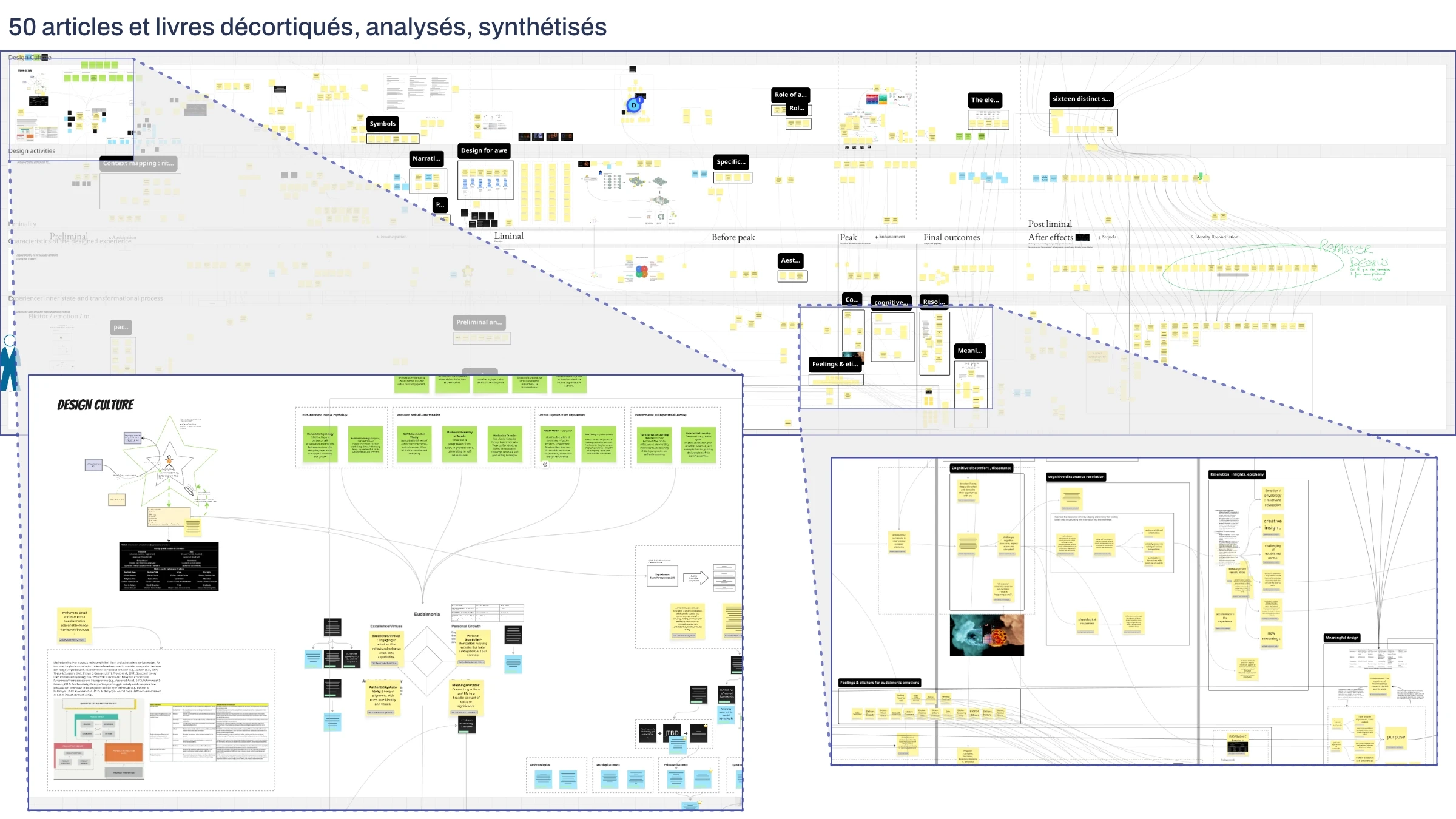
The work was not simply about collecting references. I mapped convergences, contradictions and, above all, blind spots:
overinvestment in hedonic experience;
confusion between emotional intensity and transformation;
lack of post-experience integration;
and the absence of tools linking a transformational intention to concrete Design decisions.
From there, I iterated towards a model for designing the conditions from which deep transformation can emerge.
That meant bringing post-experience integration into the heart of the method and accepting a fundamental limitation: we never design an inner experience directly. We design artefacts, situations and thresholds that may support it.
I then challenged my hypotheses with international researchers: Professor Andrea Gaggioli, whose laboratory introduced the term Transformative Experience Design, and Johan Liedgren, a pioneer of Liminal Design, supervised my work.
I also tested the resonance of the subject with 16 designers, artists, POs, PMs and CEOs.
The interest was strong.
Shift the paradigm
Transformative Design does not replace UX, Emotional Design or Strategic Design.
It adds another depth of intervention and asks a different question of quality:
does the experience merely work in the user’s life, or does it also affect how that person understands and defines themselves?
Historically, Design has primarily worked with pragmatic qualities: usefulness and effectiveness.
Then hedonic qualities: pleasure and desirability.
More recently, products and services have increasingly addressed eudaimonic qualities: meaning and fulfilment.
To operate within the transformation economy, Transformative Experience Design introduces a fourth level: metamorphic qualities, lasting shifts in how a person sees themselves, their relationship to others and their relationship to the world.

This distinction forms the basis of the paradigm. HEre, design no longer acts only on the artefact or interaction, but on a trajectory connecting a Current Self, a Transitional Self and a possible New Self.
The designer’s role is to orchestrate a potential milieu: call, rupture, protection, meaning-making, social support and integration, drawing on anthropological models of initiation and rites of passage. This position makes transformation designable without treating it as programmable.
I enter systems through lived experience, reveal their invisible structures, test them against research and make them actionable. Then I build the conditions for an idea to become a shared reality.
Éprouver, valider et publier
La méthode s’est développée au contact du terrain, notamment auprès de l’entreprise à mission Warren Walter et de son programme PimpMyApp, dispositif de professionnalisation en partenariat avec France Travail et l’APEC. L’objectif était de concevoir une expérience transformatrice pour des commanditaires réfractaires afin de redonner du sens à leur travail. Ce terrain a permis d’itérer sur tous les aspects du modèle entre les chercheurs, les designers et le terrain. C’était intense, j’ai peu dormi car le potentiel de ce sujet était clair mais énormément de travail était nécessaire. Et le résultat était là.
25 exemplaires du prototype du livre ont été envoyés à des designers seniors et head of, des chercheurs et CEO, afin d’avoir un retour « test utilisateur » de leur lecture. Un de ces exemplaires était le support de restitution de thèse auprès de l’ENSCI. Leurs retours m’ont permis de modifier le livre et ont validé son potentiel.

Fund the publication
I conceived the Playbook as a complete editorial object sitting between academic research, rite of passage, manifesto and operational handbook, with its own art direction built around the tension between rational rigour and threshold experiences.
Publishers had expressed interest, but self-publishing allowed me to preserve the integrity of the approach and its visual singularity. It also moved all of the financial risk onto me.
I designed the Ulule pre-order campaign as a funding mechanism, a desirability test and the first act of building a community.
The campaign sold 270 Playbook pre-orders in six weeks, with no distributor, intermediary or media budget.
Ultimately
Beyond writing a book about a new way of designing, I built the conditions for that practice to exist:
a body of knowledge;
a paradigm;
partnerships with foundational researchers;
a method tested in practice and challenged by peers;
a complete Playbook;
a funding model;
and the first practitioners around an emerging field.
The aim was to equip the discipline before the transformation economy becomes (just as UX did before it) a demand that organisations expect designers to answer without having had the time to prepare.
This is how I design the strategic, formal and human frameworks through which new ways of being and acting can become possible.
And if your organisation is entering the transformation economy, if your brand promises its users, customers or communities a genuinely different future state and wants that promise to become lived reality, this is where one of my expertise lies: designing the conditions that make such transformations possible.

I built the tools Design needs for the transformation economy.
Open to a permanent role
If your organisation promises meaningful change to the people it serves and wants that transformation to become lived reality, let’s talk.