
STRATEGIC DESIGN & BUSINESS DESIGN
·
DIGITAL ACCESSIBILITY
Three days to make the call on accessibility.
At Warren Walter, I turned three competing views of accessibility into one strategy and six prioritised workstreams.
In short
Warren Walter asked me to apply Design to Business and define a strategy for its digital accessibility offering, a core activity that had been stuck for some time.
Three leadership interviews later, the real problem surfaced: the agency’s decision governance was implicitly setting three different visions against one another. They had never been resolved, and the situation had been exhausting the team for months.
I designed a process that made avoiding the decision increasingly difficult: a provocative diagnosis, individual asynchronous immersion, then a three-day strategy sprint bringing all three leaders together around the issue.
The disagreements would be put on the table. And decisions would have to be made.
By the end of the sprint, the leadership team had one strategy, six prioritised workstreams, and at least one already underway within the following weeks.
Reframe the diagnosis
“Help us develop an innovative strategy for our accessibility offering” was, in short, the initial request.
From my first conversations with the three leaders, it became clear that the issue was not “an innovative strategy for an offering”. Each of them held a different, and never confronted, view of what accessibility meant for the agency.
The accessibility offering was actually the symptom of the organisation’s inability to decide between three competing visions.
For one leader, accessibility was an entry point into major accounts. For another, a social responsibility. For the third, a regulatory opportunity that needed a viable business model.
With those competing interpretations unresolved, any “good strategy” would have been premature: the activity was being pulled in three directions at once and moving forward in none.
I kept hearing:
“The three of us basically have different views of accessibility. We’re all pulling in different directions, we don’t even know where we’re going, and so we’re not moving forward.”
“Nobody takes ownership because the responsibilities aren’t defined. Compared with well-organised agencies, we just don’t hold up.”
The ambition itself was not lacking: “to become a recognised player in digital accessibility, capable of supporting organisations over the long term.”
The expertise was clearly there too. But nothing concrete supported that ambition: no stable process, no business model, no dedicated governance.
That gap between stated ambition and the inability to make it real is what quietly wears a team down without ever forcing a direct challenge to the status quo.
I formalised that diagnosis in a report that made the reassuring internal narrative, that the blockers were merely temporary, impossible to sustain.
I put the leaders factually in front of their disagreements, the constraints maintaining the status quo, but also the opportunities, existing points of convergence, decisions that could no longer be postponed, and four principles for moving forward.
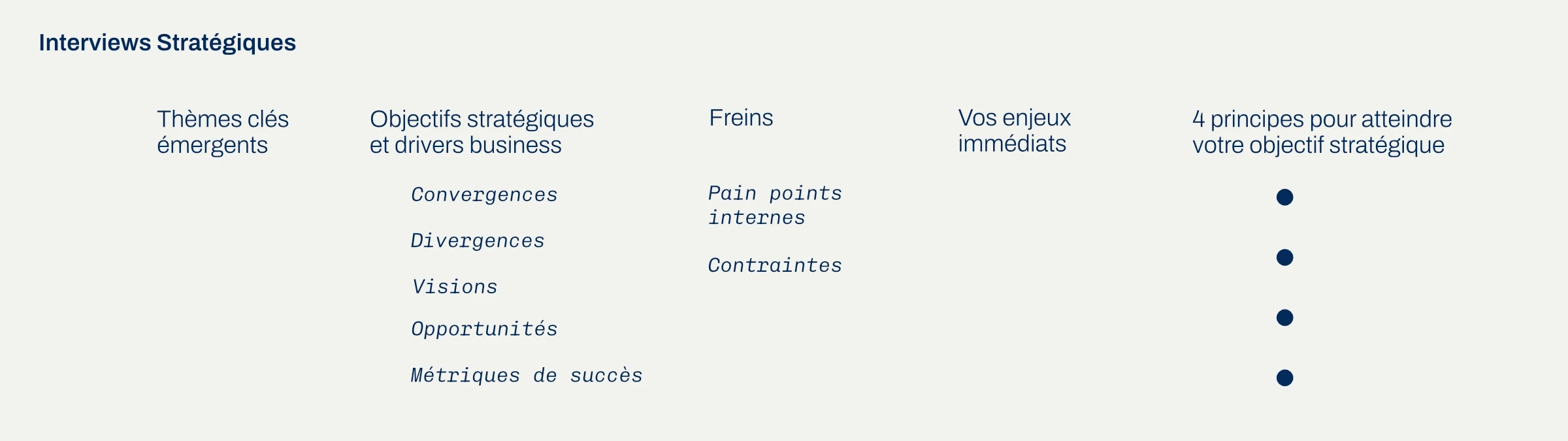
Before any collective discussion, each leader had to confront that report alone and prepare a personal journal capturing surprises, responsibilities and expectations.
The aim was for the upcoming three days (when they would be in the room together) to start from a problem that had already been named and individually owned.
Make each leader think alone first
After interviewing eight clients about what they expected from a digital accessibility agency like Warren Walter, I deliberately did not move straight into group workshops.
Instead, I guided each leader through an individual sequence across several sessions: competitive analysis, market trends, prioritisation of customer needs, and a commented reading of the diagnostic report.

The objective was to move strategic responsibility from the group to the individual before rebuilding it collectively.
Each leader then had to present their position at the opening of the sprint through an uninterrupted lightning talk, with no discussion or commentary.
There was nowhere to hide inside surface-level alignment and no possibility of building a position merely in reaction to someone else’s.
That sequence produced hypotheses that were argued, explicit and publicly owned. It was this individual preparation that made the collective sprint genuinely productive.
Co-design the decision without manufacturing consensus
designed the “business sprint” by combining decision tools from the d.MBA with co-design principles, deliberately alternating divergence and convergence.
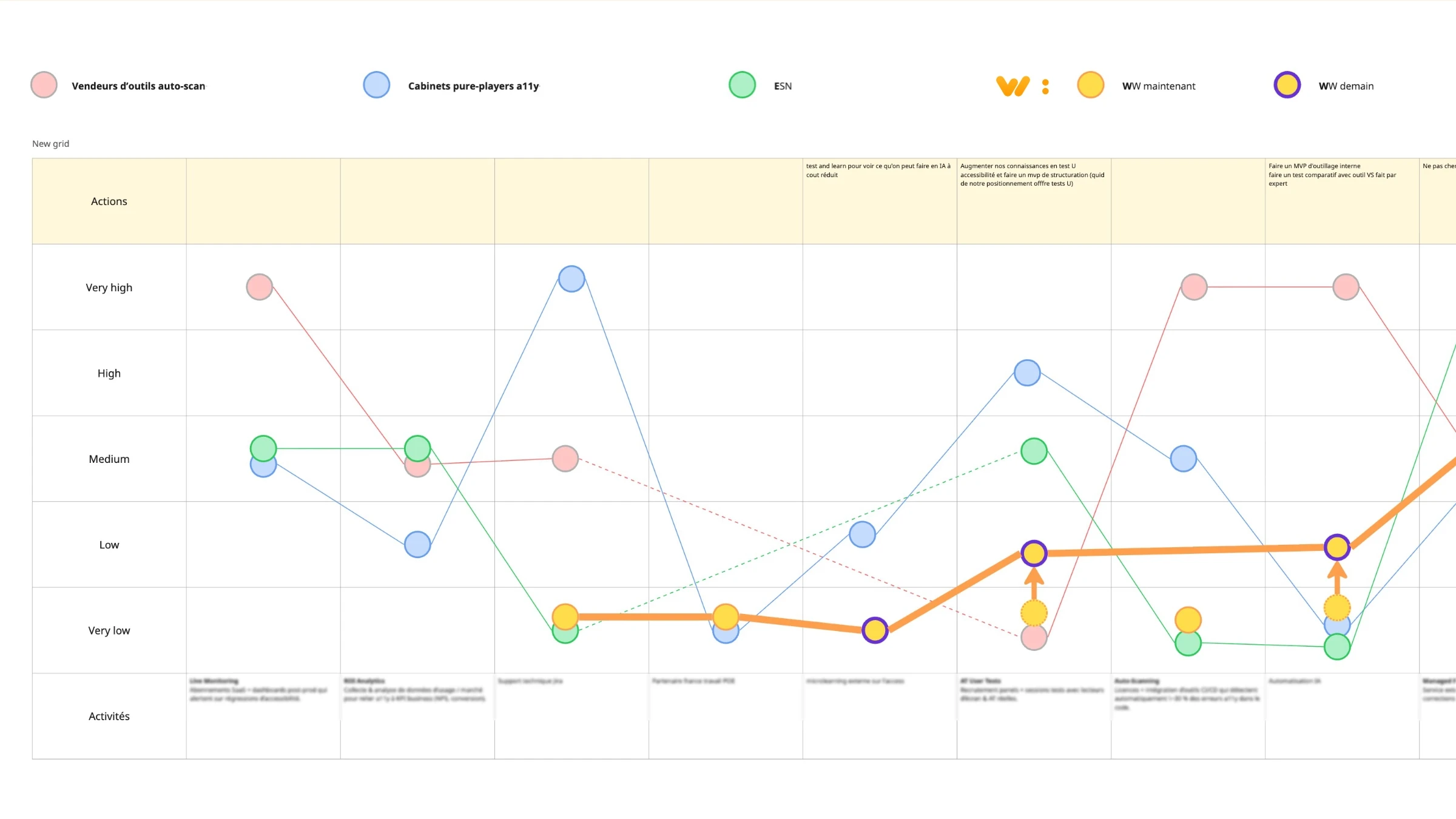
The turning point on Day 1 was the Strategic Goal: aligning three competing ambitions into one precise strategic objective while explicitly accepting what would have to be given up.
Later, over half a day, combining the ERRC matrix (Eliminate, Reduce, Raise, Create) with the positioning of Strategic Activities forced the team to name what it was prepared to stop doing.
This was where hiding stopped being possible. The real difficulty was closing doors together, out loud:
“So we agree we’re stopping this: we take it down to 0/5 in terms of investment?”
“To reach our ambition relative to competitors, we’ll need to start investing time in this activity, but not that one. Are we agreeing to that?”
Every retained option was then prioritised by perceived customer value rather than internal preference.
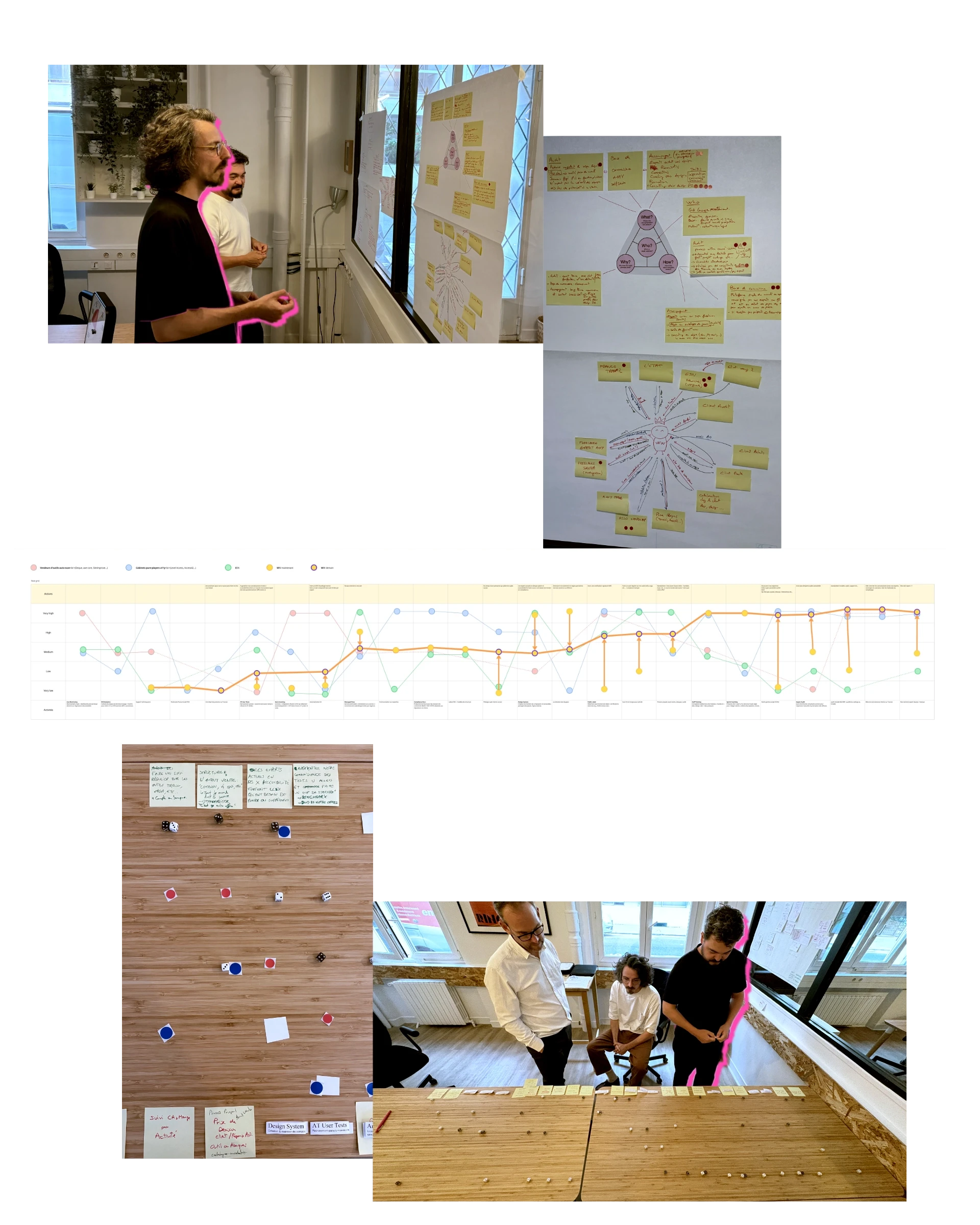
The following day, the Product Pinocchio exercise (personifying Warren Walter to define its mission, vision, values, causes and partners) helped build shared empathy for the organisation itself.
Each leader then worked alone again to propose a business model. Those models were subsequently confronted and merged as a group.
Put decisions into motion
At deliberate moments, I kept the friction rather than smoothing it away.
Anonymous votes, enforced silent work, short constrained formats, direct confrontation between proposals, followed by explicit decisions: these mechanisms reduced power dynamics and recentred the group on the decision rather than on who was advocating for it.
By the end of the sprint, decisions were experienced as collective commitments because the framework demanded full presence and made avoidance impossible.
The final hours of the sprint also surfaced residual tensions around horizontal governance, rooted in fears and unresolved past experiences around resource allocation.
The team then organised its operations to launch the workstreams needed to carry the strategy forward.
The Strategic Design process created the clarity, alignment and decisions needed to turn it into a directed activity:
one explicitly owned goal;
clear priorities;
a roadmap of workstreams to implement.
As a Head of Design, I co-build strategy and make teams capable of carrying it through.
Ultimately
The final hours of the sprint surfaced residual tensions around horizontal governance. Before the engagement, accessibility at Warren Walter was an activity delivered case by case, carried by a handful of experts and never truly steered.
The Strategic Design process created clarity, alignment and decision: one explicitly owned goal, clear priorities and a roadmap of workstreams to implement.
Postscript
The alignment achieved at the end of the sprint was real, but it remained largely cognitive.
In the final hours, different attitudes towards prioritisation and risk-taking resurfaced. This was not really a disagreement about the strategy itself; it was a horizontal governance model that had not yet learned how to make decisions on its own.
What I take from this is that a Strategic Designer can create the conditions for a decision—but must then follow through by putting in place the governance that allows that decision to live.
Three years earlier, I had used a comparable process to help the agency Design is Vital revisit its positioning and brand.
I described it in the Medium article Business Strategy × Design Sprint: rethinking a design agency’s strategy (in French).
Three days to turn divergence into decision.
Open to a permanent role
If your organisation needs to make a complex strategic call and put it into motion, let’s talk.